🍪
Skip to main content

Removing echo in large rooms: what steps should I follow

By Acoustics, Architecture, Construction, Decoration, News No Comments
Removing echo in large rooms is often the first step to achieve a comfortable space for users. In fact, traditionally it was aesthetics and decoration that were taken into account when designing large rooms but, sometimes, perhaps because of ignorance, acoustic comfort was neglected. Large rooms such as exhibition halls, dining rooms, waiting rooms, auditoriums, classrooms or offices tend to exhibit an acoustic problem similar to echo called reverberation. Reverberation is the permanence of sound beyond the time required to properly hear and understand a message. Explained in a more technical manner, “reverberation time ” is the time it takes for the sound to decay by 60 dB as received stood the sound emission source stops. Reverberation in rooms is popularly called echo, and removing echo is called acoustic conditioning. What steps should I follow when removing echo in a room?   Measuring the dimensions of a room Knowing the level of reverberation of room: When removing echo from a room we must know its level of reverberation. We can know this in two ways: taking measurements with an acoustics specialist or making an estimate with the help of an Optimum Reverberation Time (ORT) calculator like the one Spigogroup offers on its website for free. Identify the areas where you can install acoustic panels made of sound-absorbent wood: walls, ceilings, columns, etc. Choose an acoustic panel model that will allow you to eliminate the echo and get closer to Optimum Reverberation Time in the room. Again, the ORT calculator can help by guiding you on the most suitable Spigotec or Spigoacustic cladding. Choose the finish that best fits the style of the room   . If you liked this post about removing echo, you may also be interested in: . - How to reduce or eliminate echo in a room? Acoustic conditioning in romos - Insulation levels in wood soundproof doors or acoustic doors - Acoustic conditioning of culture centres: the case of the Romo Culture Centre in Getxo, Biscay - How to reduce or eliminate echo in a room? Acoustic conditioning in romos
Read More

Acoustic panels for dining rooms: the dining room of the Guipuzcoa company Danobat

By Acoustics, Architecture, Construction, Decoration, News, Spigogroup wood projects No Comments
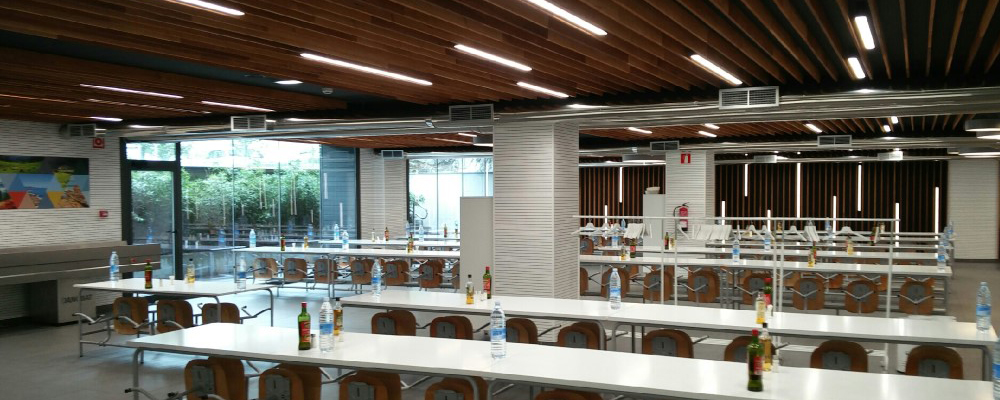
Anyone who doubts the advantages of acoustic panels for dining rooms has never entered a large room during a full meal service. The sound experience, with a full dining room, can become very annoying. In any dining room in a bar, coffee shop or restaurant, acoustic problems can surface, mainly because of uncontrolled reverberation that produces echoes and sound reminiscences that make conversations unintelligible. But when we talk about large dining rooms the need to install acoustic panels for acoustic conditioning is still more evident. If your doubts linger, visit the dining room of a college or university at lunch time, or remember the hotel buffet dining room where you spent your summer holidays, and try to remember your acoustics. Today we bring a recent work, just a few months old. It is a good example of the use of acoustic panels for dining rooms. This is the work of acoustic conditioning of the dining room of the Guipuzcoa company Danobat. We supplied 540 panels measuring 1200 x 300 cm (about 200 m²) of Spigoacustic wood panelling for walls and columns in the dining room. Spigoacustic 28 -16 -32 acoustic panels were chosen. They are 16 mm thick, finished in white melamine, and manufactured on B-s1, d0 fire-retardant MDF with 4-sided dovetailed machining and veil. The dining room already had wood slats on the ceiling, such as those manufactured by Spigoline, which together with the Spigoacustic acoustic panels for dining rooms provide warmth and elegance.   . If you liked this post about acoustic panels for dining rooms, you may also be interested in: . - Acoustic panels in the auditorium of the Qatari Ministry of Municipality and Urban Planning - Using absorbent acoustic panels can improve the look of your Project - Spigogroup launches its factory outlet of wood acoustic panels - How to choose wood acoustic panels for your Project
Read More

Frequently asked questions about wood removable ceilings

By Acoustics, Architecture, Construction, Decoration, News No Comments
What are wood removable ceilings? . A construction element, generally consisting of removable wood panels which are fixed at a certain distance from the floor and secured thereto by means of profiles and hangers. . What is the difference between removable ceilings and accessible ceilings? . Removable ceilings are those which can be removed although it can only be done by removing wood panels starting from the sides up to the point where you need to work. Accessible ceilings, however, allow you to work on a given location, removing or replacing individual panels without having to move adjoining panels. exactly on a point and can replace a panel in concrete, without moving the neighbouring panels. . Can wood removable ceilings improve the acoustics of a room? . Yes. When sound-absorbent wood acoustic panels are used for the installation of removable ceilings, these help to control reverberation, improving room acoustics. . And what is the sound absorption capacity of these removable ceilings? . It depends on the type of perforation employed to when the acoustic panels are manufactured. Depending on the type drilling one can distinguish between grooved, circular or square perforations acoustic removable ceilings. Of course, if required, there are also smooth ceilings without any drilling. As guiding values; since there are many variables that influence the results (plenum, insulation densities, air chamber, thicknesses, etc.), we could review the following: . - The acoustic removable ceilings with circular perforations, they offer (depending on model) an overall average NRC (Noise Reduction Criteria) of 0.55 and an overall average absorption coefficient of 0.43 (0.00 being a lack of absorption and 1.00 total absorption of incident sound). - The acoustic removable ceilings with grooved perforations, they offer (depending on model) an overall average NRC (Noise Reduction Criteria) of 0.70 and an overall average absorption coefficient of 0.59 (0.00 being a lack of absorption and 1.00 total absorption of incident sound). - The acoustic removable ceilings with squared perforations, they offer (depending on model) an overall average NRC (Noise Reduction Criteria) of 0.70 and an overall average absorption coefficient of 0.62 (0.00 being a lack of absorption and 1.00 total absorption of incident sound). . . And where can these acoustic removable ceilings be used? . Acoustic removable ceilings are widely used in acoustic conditioning projects in offices, meeting rooms, restaurants, auditoriums and other rooms where there are many people at a time and good acoustics is necessary. . What finishes can wood removable ceilings have? . Wood removable ceilings can be finished in wood or colour melamine. We can also opt for finishes in natural varnished wood (beech, oak, maple, cherry, etc.). You can even choose RAL or NCS lacquer finishes or veneering with high pressure laminates (HPL) . Are wood removable ceilings eco-friendly? . They can be if they are manufactured with eco-friendly wood. Spigogroup has PEFC and FSC certification. These certifications guarantee that the wood used comes from sustainably managed forests and that the wood panel has also been prepared by a manufacturer who guarantees that a PEFC or FSC chain of custody system is maintained right through to the end product. . .Do removable ceilings improve the energy efficiency of a building? . Removable ceilings reduces the power used to air condition the rooms of a building. By lowering the height of the roof, the volume of air which needs to be heated or cooled is also reduced for a given level of thermal comfort. In addition, the air space that forms below the main ceiling also provides thermal and acoustic insulation for the room. . What about the space between the removable ceilings and the original ceiling or plenum, Is it usable? .. Yes. This space “left” by removable ceilings serves to house hidden wires and pipes needed for devices in the building’s various installations: electricity, heating, gas, air, sound or safety. . What safety elements can be integrated in removable ceilings? . Among the most common safety elements that we can discover in the removable ceilings are fire-fighting systems, smoke detectors, motion sensors, alarms and security cameras, and other more advanced devices of the latest domotic systems for special buildings. .   . If you liked this post about frequently asked questions about wood removable ceilings you may also be interested in: .   - Wood removable ceilings – Materials choices for supporting panel - Acoustic removable ceilings - Sound absorption levels - Removable ceilings and accessible ceilings with circular perforation panels - Removable ceilings and safety components - 16 posts on wood ceilings, acoustic ceilings, accessible ceilings and removable ceilings - Removable ceilings and accessible ceilings for offices - Wood ceilings - ¿removable ceilings, accessible ceilings or fixed ceilings? - Watch out! All accessible ceilings are removable, but not all removable ceilings are accessible - Wood ceilings, or ceilings with wood panelling for brick and concrete buildings - Wood ceilings and the use of the false ceilings for acoustic conditioning in rooms  
Read More

Paneles acústicos, acoustic panels, panneaux acoustiques and, now also, pannelli acustici

By Acoustics, Architecture, Construction, Decoration, News No Comments
Acoustic panels in Italian is: pannelli acustici. We knew it before and we read about it, but now we also write about controsoffritto in legno (wood ceilings), lastre di legno (wood slats), porte tecniche (technical doors) mobilio sportivo (sport furniture) y quadri acuctici (acoustic pictures). The Spigogroup website is a living entity that grows, changes and improves as we detect new information requirements in our clients and partners. In the last months, we have incorporated new microsites devoted exclusively to products for which we usually receive orders and queries, such as phenolic cabins, phenolic lockers, fire doors and acoustic doors. We inaugurated an Outlet section with acoustic panels in stock from Spigotec and Spigoacustic with express delivery and very special prices. We have also published the latest digital versions of the new Spigoacustic, Spigotec, Spigocompac, Spigodoor and Spigoline catalogues. From the beginning the Spigogroup website was written in three languages: Spanish, English and French. Now Spigogroup launches its website in Italian with all the information about our cladding, wood ceilings and acoustic panels for Italy. The Italian market is particularly sensitive to construction products made of wood with certified quality systems such as ours. After all, Italy has been one of the great originators of world architecture. The grandiose architecture of ancient Rome was one of the most significant testimonies of its civilization. Since then, Italy has not failed to contribute illustrious names to the history of architecture: Miguelangelo, Alberti, Bernini, Rafael, Leonardo da Vinci, Brunelleschi, Bramante, Vignola, Renzo Piano, Carlo Scarpa, Aldo Rossi... and many others. To all our friends in Italy: Benvenuti nel sito di Spigogroup . If you liked this post about acoustic panels for Italy, you may also be interested in . - The use of acoustic panels in churches: The case of City Gates Church - Sustainability in the manufacture of wood acoustic panels and proper waste management - Decorative acoustic panels at the University of Bath (UK) - Spigogroup launches its factory outlet of wood acoustic panels
Read More