🍪
Skip to main content
Controlar la reverberación acústica con paneles acústicos de madera dest

4 Examples of spaces where controlling acoustic reverberation with wood acoustic panels is essential

By Acoustics, Architecture, Construction, Decoración, Decoration

Controlling acoustic reverberation is essential for enhancing the sound quality of a space and plays a crucial role in construction or renovation projects for any venue. Reverberation is the permanence of sound beyond the time required to properly hear and understand a message. Explained in a more technical manner, “reverberation time” is the time it takes for the sound to decay by 60 dB as received stood the sound emission source stops. Here are four prime examples of spaces where controlling acoustic reverberation with sound-absorbing wood acoustic panels is absolutely essential:   1. Auditoriums and theatres These spaces are specifically designed for musical and theatrical performances, demanding exceptional sound quality. In many cases, artificial amplification is either limited or non-existent, making acoustic treatment essential to ensure optimal sound diffusion for both voices and instruments. Acoustic panels installed on walls and ceilings help optimise sound distribution, prevent excessive reverberation, and guarantee an outstanding auditory experience.     2. Meeting rooms In a meeting room, speech clarity and comprehension are key to effective communication. Installing acoustic panels enhances speech intelligibility and contributes to a more productive and professional environment.       3. University lecture halls and educational centres In classrooms, sound must be evenly distributed to ensure all students can clearly hear the lecturer. Unlike theatres, these spaces generate noise from the students themselves, requiring highly efficient acoustic design. Proper acoustic conditioning ensures clear speech comprehension, promotes concentration, and fosters an ideal learning environment.       4. Recording studios and music rooms These spaces demand the highest level of acoustic control to achieve high-quality recordings. Even the slightest unnoticed reverberation can compromise a recording session, affecting the final outcome. For this reason, acoustic panels, combined with soundproofing solutions, are essential to achieving a pure and well-defined sound.           If you liked this post about controlling acoustic reverberation, you may also be interested in:   – 9 decorative wood wall panels that will add value to your decorative project – The aesthetic and optical effect of parallel wood slats – The use of decorative wood panels in nordic or scandinavian decoration – How to carry out wood acoustic panel maintenance    

Read More
opciones de placas acústicas de madera para techos dest

Spigotec families: acoustic wood tiles options for ceilings

By Acoustics, Acústica, Architecture, Arquitectura, Decoración, Decoration, Inspiration

Spigotec is Spigo’s range of acoustic wood tiles for ceilings. Wood false ceilings, wood ceilings and wall coverings, specially designed for enclosed spaces in which aesthetics and acoustic conditioning are earmarked astheir best attributes. . In the search for acoustically pleasant environments, acoustic ceiling tiles have become a widespread solution in both commercial and residential spaces. Of the many materials available, wood acoustic panels stand out not only for their aesthetics but also for their functional advantages. . There are about 41 models of Spigotec acoustic wood tiles for ceilings. All the models are resistant to fire and humidity, they are very easy to install and offer different degrees of acoustic absorption according to the needs of each project. . Depending on the type of perforation they feature, the Spigotec catalogue of acoustic wood ceiling panels is divided into six families. . . • Model Plain: without perforations. See model • Circular perforation models: 12 tiles with circular perforations offering weighted absorption coefficients between 0.208 and 0.518, and a perforated surface area percentage between 1.20% and 11.10%. See models • Grooved/ovoid perforation models: 9 tiles with grooved/ovoid perforations offering weighted absorption coefficients between 0.348 and 0.593, and a perforated surface area percentage between 6,50% and 17,72 %. See models • Squared perforation models: 3 tiles with squared perforations offering weighted absorption coefficients between 0.377 and 0.487, and a perforated surface area percentage between 7,70 % y 25,00 %. See models • Microperforated models: 9 tiles with microperforated perforations offering weighted absorption coefficients between 0,1 (LM) and 0,554, and a perforated surface area percentage between 0,68 % and 11,80 %.   See models . • Special models: 7 tiles with special perforations offering weighted absorption coefficients between 0.070 y 0.498, and a percentage of perforated surface of up to 10,65 %. See models . . If you liked this post about acoustic wood tiles options for ceilings, you may also be interested in:   . – Solid wood slat ceilings for the Finanzauto offices in Chiva . – Wood lath and slat cladding in new coworking spaces: the case of Coworking Hiptown in Paris . – Interior wood cladding at the new Práxedes Mateo Sagasta Secondary School in Logroño . – Technical doors for schools – Instituto Práxedes Mateo Sagasta in Logroño

Read More
techos desmontables decorativos de madera dest

6 frequently asked questions about removable decorative wood ceilings

By Acoustics, Architecture, Construction, Decoración, Decoration

Removable decorative wood ceilings are made of wood panels laid out on a fully standardised grid system, for quick and easy installation from the sides of a room. In this post we are going to try to resolve the six most common doubts about this constructive and decorative resource.       What material are removable ceilings made of? They can be manufactured with different materials but usually wood is used as a material that, in addition to offering good acoustic performance, also adds value from the point of view of aesthetics.   Some removable ceilings are acoustic removable ceilings, how do we distinguish them? At first, acoustic removable ceilings stand out for the perforations on their surface, which provide the different levels of sound absorption in the different models. On the back, removable ceilings also have a black veil that completes the acoustic sound-absorbing properties of the wood panels.   What type of main base plate or support can the acoustic panels of removable wood ceilings have? – MDF Standard Support: Medium-density fiberboard support is destined to an use in dry environments – Fire – Retardant MDF Support: Medium-density fiberboard support with improved fire reaction. – Moisture – Resistant MDF Support: Medium-density fiberboard support with is resistant to moisture – Plywood Support: It is a support with wood thin layers which are glued transversally with syntentic resins through strong pressure and heat.         What is the space between the removable decorative wood ceilings and the original ceiling used for? In addition, removable ceilings offer a space between the false ceiling and the main ceiling. This space “left” by removable ceilings serves to house hidden wires and pipes needed for devices in the building’s various installations: electricity, heating, gas, air, sound or safety.   Are they also used to house security elements? Yes. Among the most common safety elements that we can discover in the removable ceilings are fire-fighting systems, smoke detectors, motion sensors, alarms and security cameras, and other more advanced devices of the latest domotic systems for special buildings.   What differentiates a removable ceiling from a accessible ceiling Removable ceilings are those which can be removed although it can only be done by removing wood panels starting from the sides up to the point where you need to work. Accessible ceilings, however, allow you to work on a given location, removing or replacing individual panels without having to move adjoining panels. exactly on a point and can replace a panel in concrete, without moving the neighbouring panels.             If you liked this post about flame removable decorative wood ceilings, you may also be interested in: – Installation of solid wood slat cladding using the GRID system – Wood ceilings for wineries: tradition and modernity in the great temples of wine – Why is wood one of the best materials for decorating and constructing buildings? – Definition of acoustic conditioning and soundproofing, what is the difference?    

Read More
techos registrables de madera para ayuntamientos dest

What facilities are accommodated by accessible wood ceilings for town halls?

By Acoustics, Architecture, Construction, Decoración, Decoration

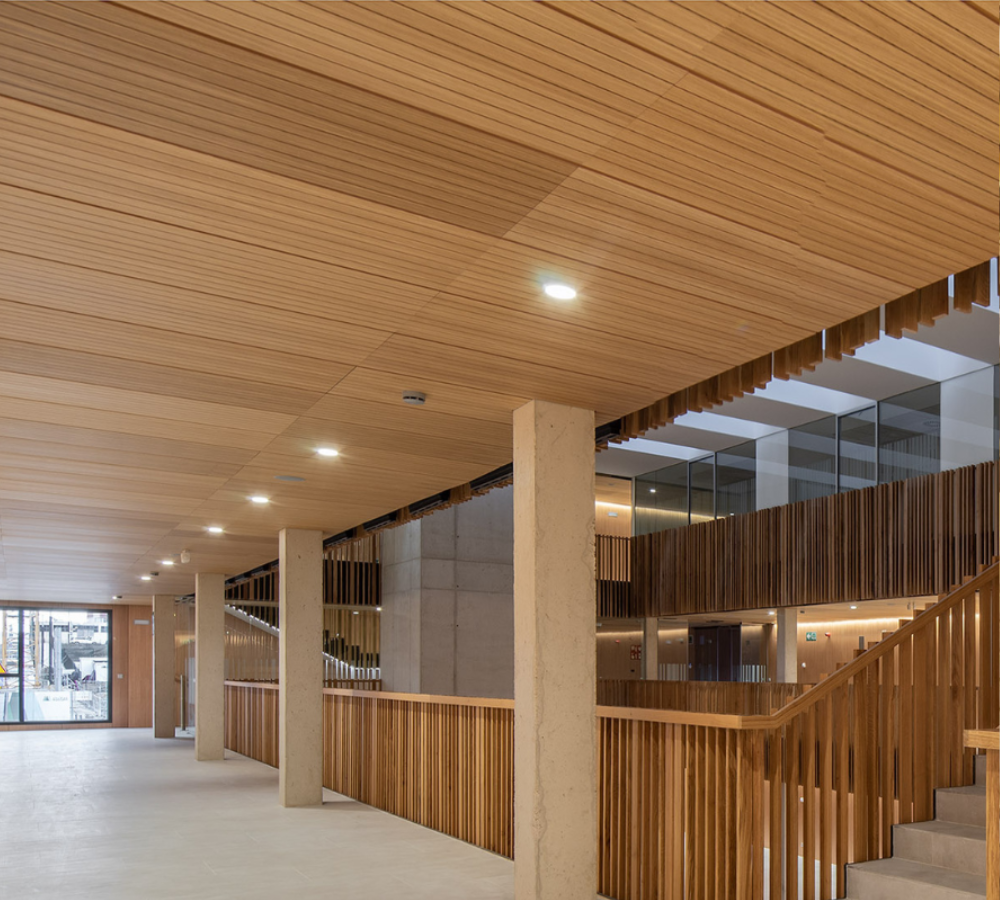
Accessible wood ceilings for town halls are those ceilings that allow the independent, quick and agile installation and disassembly of each panel as many times as desired. This quality is especially useful for integrating and maintaining accessories such as ventilation grilles, fire or security sensors, luminaires, speakers, or to allow access to the plenum. Let’s take a closer look at which facilities can accommodate wooden log roofs for town halls.   Lightning The accessible wood ceilings allow the integration of recessed lights, LED panels and indirect lighting systems, and keep the corresponding tangle of wiring hidden in the plenum.   Air conditioning The ceiling of any municipal room houses air ducts, diffusers and ventilation grilles. The accessible ceilings allow easy access for maintenance and allow all tubes and conduits to be hidden, also in the plenum. This integration capacity helps maintain thermal comfort without compromising the aesthetics of the space.   Acoustics and sound systems The accessible wood ceilings can accommodate speakers, microphones and other components, ensuring uniform sound distribution and facilitating access for adjustments and repairs. Furthermore, if we use wood acoustic panels on the accessible ceiling, this will serve to acoustically condition the room.   Electricity and data Accessible ceilings are perfect for housing, in an orderly, accessible and, above all, concealed manner, both electrical and data wiring and access points to Wi-Fi networks.   Sensors, security and surveillance Surveillance cameras, smoke detectors and alarms can also be easily integrated into accessible wood ceilings. Additionally, many public buildings are adopting sensor and automation systems that control lighting, HVAC and other systems, optimizing energy use and improving building functionality             If you liked this post about accessible wood ceilings for town halls, you may also be interested in:   – 21 Articles on acoustic conditioning and insulation with wood – Ecological panels with SPIGOLINE PET slats: Solid slats or MDF slats? – Restaurant décor: the 3 mistakes you can’t make in 2024 – The importance of acoustics in coliving or cohousing    

Read More