🍪
Skip to main content
wood sound-absorbent panel dest

Spigoacustic families: wood sound-absorbent panels options

By Acústica, Architecture, Arquitectura, Construcción, Decoración, Decoration

Spigoacustic is Spigo’s range of wood acoustic absorption panels, made up of linear sound-absorbent panels or acoustic panels designed to offer an optimum acoustic performance. Spigoacustic sound-absorbing panels decorate walls and ceilings of all types of premises: auditoriums, hotel halls, exhibition halls, university classrooms, hospital waiting rooms, dining rooms, board and meeting rooms, professional offices, etc. There are about 29 models of Spigoacustic acoustic panels. The technical nomenclature of each model includes three numbers, which correspond to three measurements in millimetres. The first is the width of the groove on the visible side. The second is the distance between perforations on the hidden side of the panel. And the third is the distance between grooves on the visible side.   Based on the visible channel width, the Spigoacustic catalogue of wood sound-absorbent panels is divided into four families:   • Model Plain: Model plain View model • Models with 2 mm channel: 10 panels with various combinations of the distance between perforations (16 or 32 mm, or without perforations) and distances between grooves of 8, 16, 32, or 64 mm. View models  Models with 2,8 mm channel: 9 panels with various combinations of the distance between perforations (16 or 32 mm, or without perforations) and distances between grooves of 16, 32, or 64 mm. View models • Models with 4,2 mm channel: another 9 panels with the same combinations as the 2.8 mm channel width family. View models   If you liked this post about wood sound-absorbent panel, you may also be interested in:   – Technical carpentry and acoustic doors for the Villanueva health centre in Logroño – Wood acoustic tiles to create more humane and sustainable spaces – How do we work at Spigo? More than just making wood acoustic panels – Slats and decorative wood slats cladding at the Cachan university restaurant  
Read More
mantenimiento de paneles acústicos de madera dest

How to carry out wood acoustic panel maintenance

By Acoustics, Architecture, Construction, Decoración, Decoration

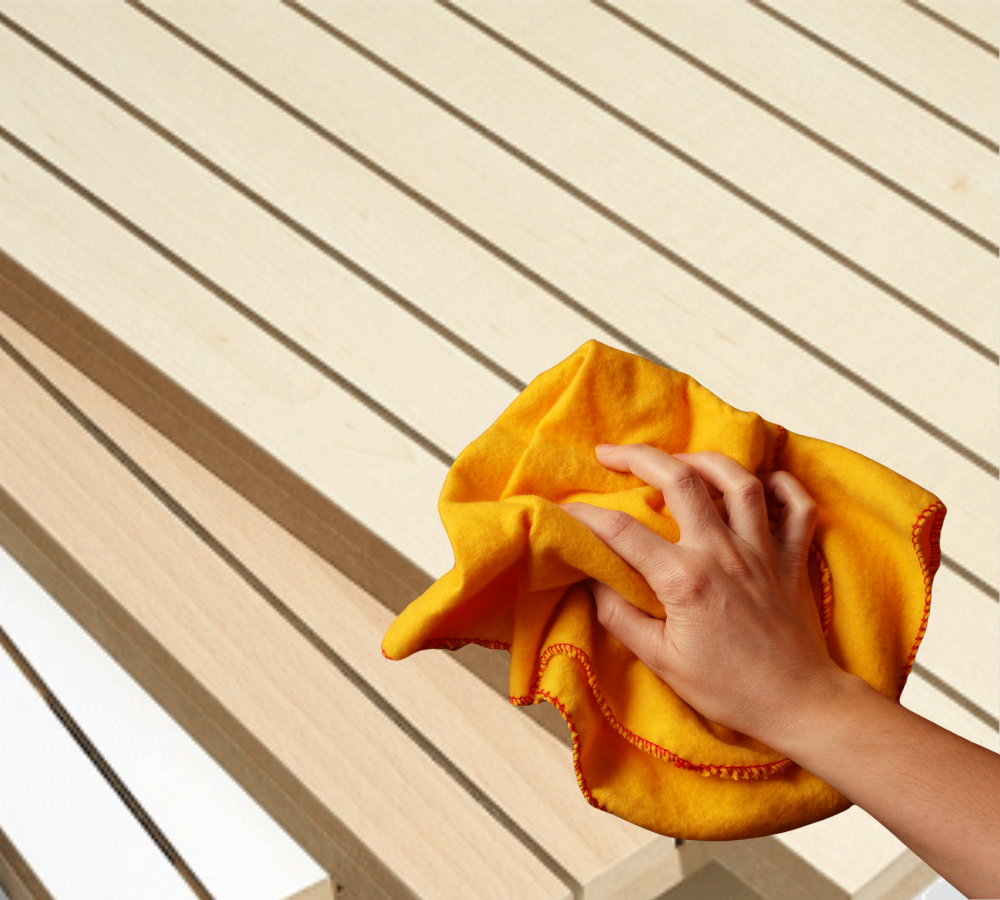
Although wood acoustic panel maintenance is a relatively simple task, it is important to carry it out so that both their sound absorption and aspect remain the same. In this respects, there are two different moments: panel maintenance before installation (of interest to fitters and installers) and their maintenance once they have been installed in their final location:   Wood acoustic panel maintenance before installation. The place where wood acosutic panels are kept should be kept clean, dry and well ventilated. It is essential that panels be protected from humidity and rain, as water absorption can cause deformation. We therefore recommend that the material be unpacked at the time of installation and that the panels be kept for 24 to 48 hours at their final destination before being installed, in order to ensure that they adapt to the environment. Please remember that the original packaging does not protect the material from rain, moisture and impact and that no loads should be placed on top of the material. The place where the panels are installed should be under a roof and not have more than 60% humidity.   Wood acoustic panel maintenance after installation. Dust and dirt on the surface of the panels can be removed using a damp cloth. Never use abrasives or products containing silicone. Any residual moisture on the surface should be thoroughly dried after cleaning to prevent damage. It is imperative that the structure of the panel is not damaged during cleaning.     . If you liked this post about wood acoustic panel maintenance, you may also be interested in:   – 21 Articles on acoustic conditioning and insulation with wood – Ecological panels with SPIGOLINE PET slats: Solid slats or MDF slats? – Restaurant décor: the 3 mistakes you can’t make in 2024 – The importance of acoustics in coliving or cohousing    

Read More
https://portal.gestion.sedepkd.red.gob.es/portal/espacio

Which decorative wood panels are sound-absorbent and which are not?

By Acoustics, Acústica, Architecture, Arquitectura, Construcción, Construction, Decoración, Decoración, Decoration

Decorative wood panels are a popular choice in interior design, not only for their aesthetic appeal, but also for their acoustic properties. However, it is important to understand that not all wood panels are sound-absorbent, and their ability to improve acoustics depends on their design and composition. Sound-absorbent decorative wood panels Sound-absorbent panels are specifically designed to improve sound quality by enabling acoustic conditioning. They are made of materials that absorb sound waves, preventing them from being reflected and helping to control acoustic reverberation, defined as the time lapse from the moment when a sound source stops emitting sound until the energy reaching the receiver decreases by 60 dB. These panels are usually composed of a combination of wood and absorbent materials, such as the 0.25 mm sound-absorbent acoustic veil attached to the back of Spigoacustic and Spigotec wood acoustic panels. These panels have grooves or perforations on the surface of the wood, allowing sound to penetrate and be absorbed by the underlying material. Depending on the percentage of perforated surface, they will have greater or lesser sound absorption. Finally, the visible surface of the panel has an aesthetic finish that can range from varnished natural wood to different melamine, lacquer and HPL options.   NON sound-absorbent decorative wood panels On the other hand, NON sound-absorbent decorative wood panels are designed only for aesthetic purposes and do not provide an acoustic improvement to the room where they are installed. These panels are usually made of wood without perforations or additional sound-absorbing materials. If you liked this post about decorative wood panels, you may also be interested in: – The need for acoustic conditioning in tourist offices – 24 articles about decorative wood slats for walls and ceilings – 6 frequently asked questions about removable decorative wood ceilings – the acoustic conditioning of school canteens

Read More

The importance of acoustics in coliving or cohousing

By Acoustics, Architecture, Construction, Decoration, News No Comments

Good acoustics in coliving or cohousing improves the quality of life of the residents, but where and how do acoustics affect this new type of housing? Coliving or cohousing is a form of shared housing in which tenants have a private area consisting of a separate bedroom, usually with a bathroom and kitchen, and common spaces for shared use such as a kitchen, dining room, coworking spaces, library, gym, multimedia rooms, swimming pool, sports facilities or large living rooms. The acoustic conditioning of these rooms ensures common spaces with good acoustic comfort, promoting coexistence and well-being. One of the most attractive and functional solutions to address the improvement of acoustics in coliving or cohousing is the installation of wood acoustic panels. These panels are designed to effectively absorb and diffuse sound, thereby reducing reverberation and unwanted noise. Wood is an excellent material for this, as it is aesthetically pleasing and blends well into most interior designs. Many coliving or cohousing projects are already incorporating wood acoustic panels from the Spigoacustic, Spigotec or Spigoline families in the design of their common areas. The ecological and sustainable origin of the wood from which they are made, the warmth and elegance they bring to any interior design and the guarantee of being able to offer healthy spaces from the point of view of acoustics are key factors in making this decision. If you have any questions, please contact Spigogroup’s technical department: comercial@spigogroup.com           If you liked this post about acoustics in coliving or cohousing, you may also be interested in:   – Why is wood one of the best materials for decorating and constructing buildings? – Definition of acoustic conditioning and soundproofing, what is the difference? – Request a quotation for acoustic panels and wood panelling – Interior design of hotels: the importance of acoustics in hotel reception areas    

Read More