🍪
Skip to main content

Undulating wood ceilings of One Main Office renovation

By Architecture, Construction, Decoration, Inspiration, News No Comments
Undulating wood ceilings are rare and hard to find. Although wood is a flexible material it is not easy to make wood ceilings that imitate waves, dunes or similar patterns because, quite obviously, they are harder to make from a technical point of view than flat ceilings. Wood ceilings are very beautiful, pleasant, elegant and convey the feeling of warmth, of being at home. And curved wood ceilings are also original. The design ceilings made by Spigogroup for the Fundación Riojana para la Construcción or for this small condominium entrance in the Navarrese town of Estella are good examples. But today we are talking about something else, of undulating wood ceilings that envelop the user of a room. Wood ceilings that also blend into the floor and walls like this one which we recently discovered and bring to our blog. This is the project of the renovation carried out by dECOi Architects studio in 2009 for the offices of an investment group in Cambridge (USA) using green building techniques and clean energy technologies (CChange). For the manufacture they used mainly Finnish spruce wood veneer from sustainable forests. The 1000 m2 project was nested in 1200, 13-mm thick, 120 x 365 cm sheets, mechanically milled with high precision according to the indications of the studio and assembled on site. Photographs by Anton Grassl obtained from decoi-architects.org .           . If you liked this post about undulating wood ceilings, you may also be interested in: - 5 Reasons to choose a wood ceiling for your Project - Curved wood walls and curved wood ceilings - Sizes and finishes - Wood ceilings in churches: Church of San Francisco de Castro, Chiloé Islands, Chile - Environmental advantages of using wood walls and wood ceilings
Read More

Characteristics and technical properties of lockers for changing rooms manufactured with phenolic panel

By Architecture, Construction, Decoration, News No Comments
The lockers for changing rooms manufactured with phenolic panel, or phenolic lockers, bring together a number of technical properties that place them the first positions among the models used in changing rooms in factories, gymnasiums, swimming pools and schools, ahead of other options such as wood lockers or metal lockers. Precisely what makes this kind of lockers for changing rooms special is the compact phenolic board with used to manufacture them: a high pressure laminate consisting with several layers of kraft paper pressed at high temperatures to form a laminate, with a thickness of 12 mm in the case of Spigocompac. This compact phenolic board or phenolic panel has the features that make phenolic lockers in the perfect lockers for changing rooms:   Improved fire-reaction Moisture resistance Path resistance Resistance to scratches and impact Easy maintenance Antibacterial . From a more technical point of view, the standard compact phenolic board which are used to make phenolic lockers by Spigocompac (division of Spigogroup devoted to sports furniture), have the following characteristics: . Density: 1,35 g/cm³ Scratch Resistance EN 438-2, 25: Class 2/3 Impact Resistance (Large Ball) EN 438-2 21: <= 10 mm Light Fastness EN 438-2, 27: 4-5 Grey Scale Fire Rating: C-s2, d0 Resistance to Cigarette Burns EN 438-2, 30: Class 3 Immersion in Boiling Water EN 438-2, 12: Class 3/4 Resistance to Dry Heat EN 438-2, 16: Class 3/4 Resistance to Water Vapour EN 438-2, 14: Class 3/4 Stain Resistance EN 438-2, 26: Class 4/5   EN438 Class Definitions: Class 1: Blisters and or delamination - Class 2: Marked loss of gloss and or colour - Class 3: Moderate loss of gloss and or colour - Class 4: Slight loss of gloss and or colour - Class 5: No visible change .   . If you liked this post about lockers for changing rooms, you may also be interested in: . - Buying phenolic lockers. Necessary information: models, finishes, fittings, etc … - Phenolic lockers for changing rooms - Finishes and complements - Phenolic booths and phenolic lockers for hospitals and health centres - Phenolic lockers and phenolic booths, perfect for sports facilities
Read More
Paneles acústicos

Flame retardant acoustic panels and their classification according to tests carried out on their supports

By Architecture, Construction, Decoration, News No Comments
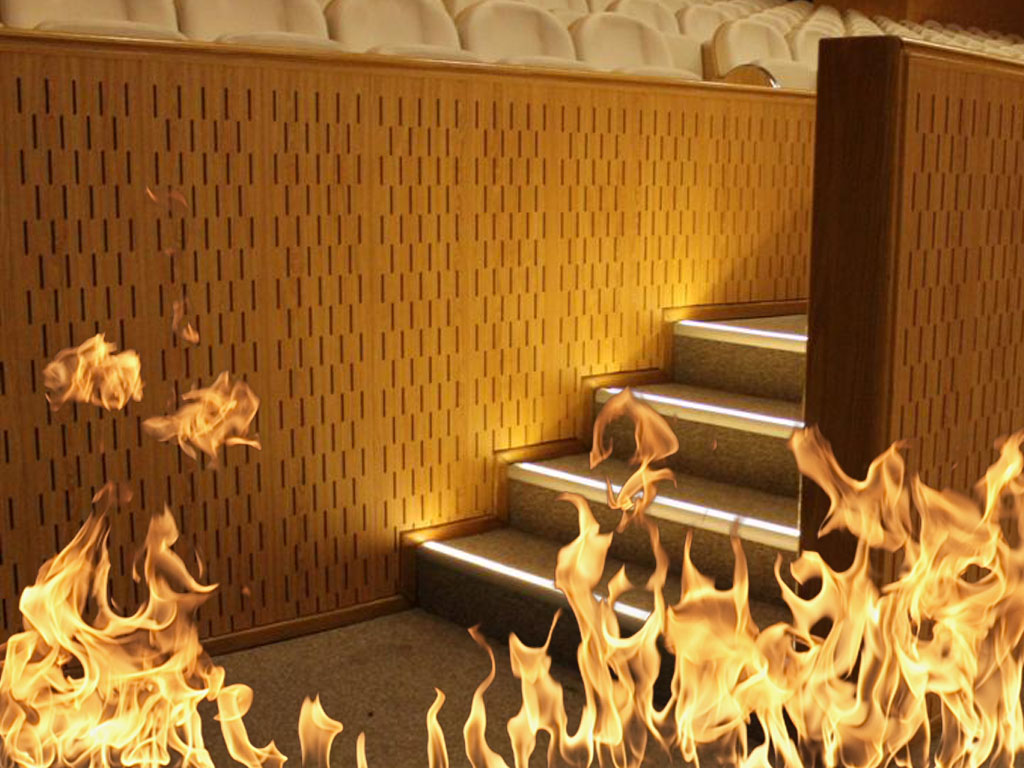
In daily nomenclature, reference is made to flame retardant acoustic panels as those that perform under or react to fire in a special way. These acoustic panels with improved fire performance can be classified according to the Euroclass system, harmonised in Spain through Royal Decree RD 312/2005 (modified by RD 110/2008) by which the fire classification of construction products and construction elements was approved according to their reaction properties and resistance to fire. The Euroclass system, also applicable to fireproof acoustic panels, arranges products according to their reaction to fire in tests, which fundamentally encompass three criteria or classes: .   A main class regarding its contribution the fire: establishing a classification A1-A2-BCDEF where "A1" is the best reaction because the product does not contribute to the fire when there is no generalised sudden combustion does, and "F" the worst since it does not have any fire resistance. A subclass regarding the opacity of the fumes produced: establishing a classification s1-s2-s3, where "s1" represents the lowest values ​​in smoke emissions, and "s3" the worst. A subclass regarding the emission of droplets and/or particles: establishing a classification d0-d2-d2, where "d0" is the best value and "d2" is the worst. . These criteria or classes allow for 40 different classifications: . . The flame retardant acoustic panels made of wood manufactured by Spigogroup under the Spigotec and Spigoacustic brands, have different reaction values ​​and fire performance. According to Euroclass classification, and depending on the substrate used, Spigotec and Spigoacustic flame retardant acoustic panels made of wood by have the following classifications:   Reacción al fuego D-s2, d0 Reacción al fuego B-s1, d0 . If you liked this post about flame retardant acoustic panels, you may also be interested in: . - Frequently asked questions about wood fire doors - 100 Combinations of Fire Resistant Doors (FR Doors) made of wood - New Spigogroup wood solutions catalogues - Using absorbent acoustic panels can improve the look of your Project  
Read More

How to choose wood acoustic tiles for your project?

By Acoustics, Architecture, Construction, Decoration, News No Comments
You already know that your project needs wood acoustic tiles to help reduce or eliminate the effects of reverberation. You know that, if the ceiling tiles are made of wood, they will offer you an extra-elegant look and that, just by themselves, they can transform a space into a much more cosy and elegant place. But what wood acoustic tiles are ideal for your project? What factors should you take into account when choosing? Let's see: . What kind of acoustic ceilings do you want? At this point you can identify two main types of wood ceilings with acoustic tiles: removable ceilings and accessible ceilings. Wood removable ceilings are those that allow for quick and easy placement but that, in some cases, do not allow for sockets everywhere. Accessible ceilings, on the other hand, do allow it and while the removable ceilings force you to dismantle the entire ceiling to replace a panel, accessible ceilings allow for quick replacement of wood panels in the exact location on the ceiling where you wish to place. . Need for sound absorption Spigogroup has three brands of tiles for wood ceilings: Spigotec, with 40 different models of wood acoustic tiles; Spigoacustic, which offers another 30 different models and Spigoline with almost 20 models of acoustic tiles with wood slats. Each of them has a different acoustic absorption depending on the needs of your project. . Type of ceiling tile support With regard to support, there are different types of ceiling tiles, Standard MDF, Fireproof MDF, water resistant MDF and plywood. . Finishing options for wood acoustic tiles Once you have chosen the desired acoustic absorption and the type of support for the ceiling tile, you need to decide on the finish. There are many options: melamine (white, stainless, maple, beech, oak, pear, cherry and wenge) natural wood (maple, beech, oak and cherry), through-dyed MDF (blue, green, red, yellow and grey), custom lacquered and HPL. The Spigoline models of acoustic tiles made with wood slats include a natural obeche wood finish, wood shade obeche wood (beech, oak, cherry and wenge) or RAL colour shade obeche wood (white, orange, red or green). . . . If you liked this post about wood acoustic tiles, you may also be interested in: . - Spigogroup wall and ceiling panels: brands and characteristics - Decorative ceilings that improve acoustics in enclosures - 5 Reasons to choose a wood ceiling for your Project - Acoustic design ceilings: the fusion of aesthetics and technology
Read More