🍪
Skip to main content

Entrance lobby renovation: how to improve aspect and acoustics in one step

By Acoustics, Architecture, Construction, Decoration, News, Spigogroup wood projects No Comments
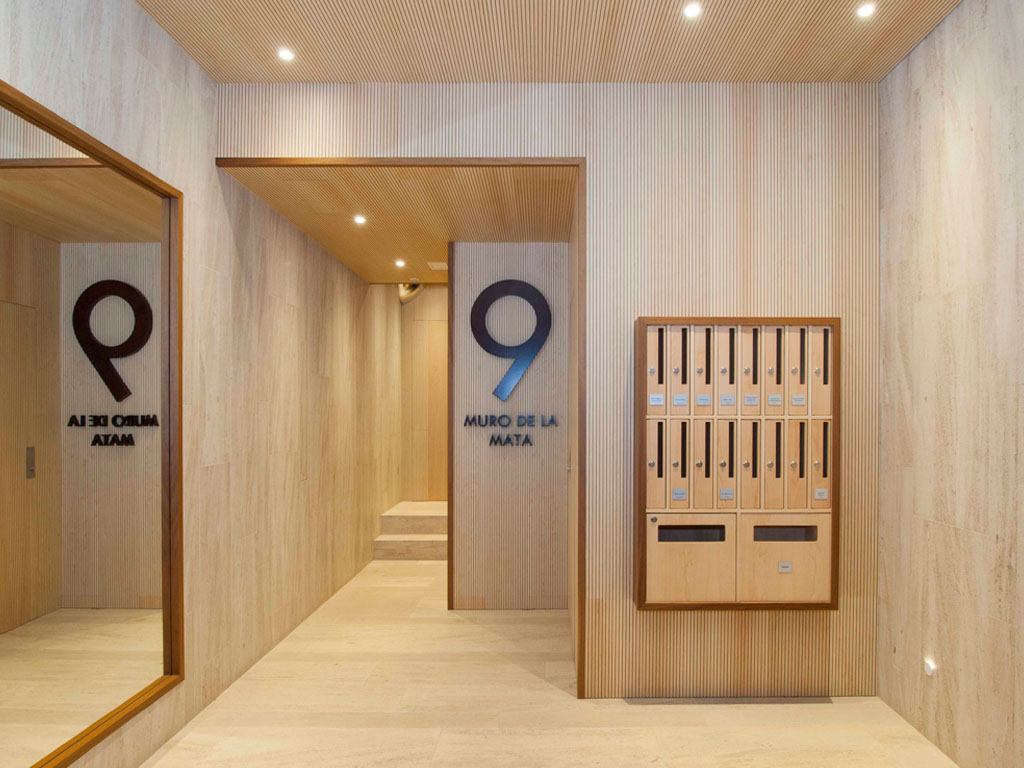
The main reasons to carry out an entrance lobby renovation is to bring the premises up to date or to undertake some kind of improvement in security or accessibility. In both cases an entrance lobby renovation may be the perfect time to also improve your acoustics. Many entrance lobbiess tend to have reverberation problems. Entrance lobbies normally have floors and walls made of non-porous ceramic, mirrors and other glass surfaces. They usually have no windows or furniture and this results in annoying acoustic effects. The solution to these acoustic problems involves the use of sound-absorbent acoustic panels in walls and/or ceilings. If, in addition, you choose wood acoustic panels, you will be able to provide major aesthetic value to the entrance lobby, giving it a modern, luminous and very elegant style. This is the case of the renovations carried out in the entrance lobby of No. 9 of Muro de la Mata, in Logroño, designed by the architecture and engineering studio Faber 1900. The project was carried out with Spigoacustic acoustic panels, model SA 28-16-16, and finished in natural varnished maple veneer. In total, more than 200 m² of cladding were installed (with pre-stripping) on the walls, ceilings and the lift casing, as well as the letterboxes and trimming on the lift and corners. Iroko wood junction boxes were also used on the stairs and mirrors, lacquered doors for panelling, and LEDs were placed on staircase perimeters. The result was a completely updated entrance lobby, with good acoustics, which now receives visitors going to offices with elegance and distinction. . If you liked this post entrance lobby renovation, you may also be interested in: . - Undulating wood ceilings of One Main Office renovation - Wood slat panels for shops and shopping centres made of wood - Curved wood slats for spectacular design ceilings - Acoustic design ceilings: the fusion of aesthetics and technology  
Read More

The three types of office doors made of wood most commonly used today

By Acoustics, Architecture, Construction, Decoration, News No Comments
The Office Doors category includes the door models most commonly used in workplaces. Their versatility and resistance coupled with the added decorative value provided by wood, makes wood office doors the most popular choice. Spigogroup specialises in wood solutions for acoustics and construction, and Spigodoor, the division that manufactures technical doors, offers an extensive catalogue of wood office doors, available in a wide range of finishes, particularly HPL laminates (including Formica and Fundermax) with their superb resistance to impact and scratching. These are the three types of office doors made of wood most commonly used today: Basic Series Doors: They are the simplest and most popular office doors used at any point or room in an office. They come with a low density particle board or high density polystyrene core, and are available with edges made of exposed plywood, PVC or compact edges or solid jamb. Sound Series Doors: They are acoustic doors or soundproof doors, specially designed to insulate and prevent the transmission of sound between adjoining offices, helping to achieve privacy and comfort at work. In workplaces, technical doors are particularly used in offices, boardrooms or meeting rooms and small auditoriums. You can opt for 4 levels of soundproofing: 32 dB, 34 dB, 38 dB and 42 dB. Fire Series Doors: FR doors or fire doors are those capable of delaying the spread of fire from one room to another, and their use is set by legal and regulatory requirements relating to safety in building construction. FR doors are available as RF30 or RF60 with fire resistance of 30 or 60 minutes, respectively.   SEE MODELS AND FINISHES OF SPIGODOOR DOORS   .   If you liked this post about office doors, you may also be interested in:   - Fire Resistant Doors and the four basic rules for proper operation - Frequently asked questions about wood fire doors - Doors for schools, universities, secondary schools and nursery schools: technical, acoustic, fire (RF) or anti-pinch doors - Doors for hotels: FR fire doors, acoustic doors and custom wood technical doors
Read More

Wood ceilings in new Danish architecture

By Architecture, Construction, Decoration, Inspiration, News No Comments
The use of wood ceilings in Denmark is as widespread as in the rest of northern Europe. It is basically a continuation of the traditional use of what has always been the main material resource for Danish builders. However, now, the reason for using wood ceilings, cladding and walls has to do with the sustainability of wood and a global commitment to a new, environmentally-friendly architecture. They continue to prefer wood ceilings in Denmark. These are some examples of recent projects. But there are many more:   Hammershus visitor center The original ceiling of this Arkitema Architects studio project serves as a lookout from the outside while showcasing a decorative wood ceiling inside. Information and photos from rkitema.com and plataformaarquitectura.cl       Landkolonien Jomsborg / Cube Arkitekter Landkolonien Jomsborg is a new installation for children explorers, in which the choice of wood as primary sustainable material for walls and ceilings (using wood slats) evokes the forest and the activities that take place in the centre. Information and photos from cubo.dk and plataformaarquitectura.cl         Summer House / CEBRA Summerhouse located next to Vejle Fjord with wood ceilings with larch cladding that unifies the interior design. Information and photos from cebraarchitecture.dk and plataformaarquitectura.cl           Dome of Visions 3.0 Original proposal for the Aarhus modern culture centre, with a polycarbonate and wood ceiling forming a large dome. The rest of the project is entirely built in sustainable wood. Information and photos from behance.net and plataformaarquitectura.cl           Villa P / Nørkær+Poulsen Architects Another example in which wood ceilings from the outside continue inward, creating, according to the team of N + P Architecture, an honest and transparent transition from inside to outside. Information and photos from nplusp.dk and plataformaarquitectura.cl   Kannikegården Kannikegården is a new house for the council of the parish church of Ribe. The ceiling is covered with façade tiles in reddish brown hues, while the interior features wood ceilings alternating smooth panels and wood slats. Information and photos from deltarkitekter.dk and plataformaarquitectura.cl   Brick House / LETH & GORI The Brick House had two goals; to create a house that is free of maintenance for 50 years with a useful life of at least 150 years. For this they used clay blocks, bricks and wood interior cladding on walls and ceilings. Information and photos from lethgori.dk and plataformaarquitectura.cl   IBC Innovation Factory IBC Innovation Factory is a rehabilitation project to convert an old factory into a 12,800 m² educational building that serves as a training ground for future innovators. Again, wood ceilings and structures take centre stage as you raise your head in the main common rooms. Information and photos from shl.dk and plataformaarquitectura.cl         If you liked this post about wood ceilings in Denmark, you may also be interested in: - Decorative ceilings made with wood slats at the new offices of EFEBÉ Group - 5 Reasons to choose a wood ceiling for your Project - 8 Spectacular wood design ceilings that will not leave you indifferent - The use of wood panels in the new architecture of Ireland
Read More

The 10 + 1 acoustic conditioning FAQs

By Acoustics, Architecture, Construction, News No Comments
What is acoustic conditioning? Acoustic conditioning is achieved by using materials and techniques aimed at partially absorbing and partially evenly distributing the sound coming from a sound source to achieve an ideal sound field. The key to good acoustic conditioning is to perform the appropriate technical treatments to achieve optimum reverberation time depending on the room to be conditioned. We achieve this thanks to the use of sound absorbent wood in wood interiors, interior coverings, and walls and wood ceilings.   Is it the same as acoustic insulation? Soundproofing of premises is not the same as acoustic conditioning. Sound insulation is a combination of materials and techniques developed to block or attenuate the noise level in a given space in order to prevent sound from getting in or coming out. To achieve good soundproofing both insulating materials and absorbent materials, such as sound-absorbing wood, are used. The simplest example is that of a building that has to be soundproofed and protected from the noise produced by road or air traffic.   Acoustic conditioning helps control reverberation but, what is reverberation? Reverberation is the permanence of sound beyond the time required to properly hear and understand a message. Explained in a more technical manner, “reverberation time ” is the time it takes for the sound to decay by 60 dB as received stood the sound emission source stops. In short, it is an annoying acoustic effect, even more so in rooms intended for listening to music or speeches: theatres, meeting rooms, auditoriums, halls, recording studios, offices, etc.   Where are these acoustic conditioning applications carried out? The acoustic conditioning is common practice in concert rooms, auditoriums, theatres, convention centres, public buildings, etc., and also in boardrooms and offices where excellent sonority is required. Because of this, sound conditioning such premises is achieved using acoustic material, such as sound-absorbent wood panels, and acoustic ceilings and acoustic panels.   How is acoustic conditioning carried out in a room? The acoustic conditioning of a room can be carried out by installing sound-absorbent wood acoustic panels that would limit the reverberation time and therefore improve interior acoustics. These wood panels have grooves and circular holes in different densities, shapes and sizes, and they determine the degree of absorption of each of the existing models of acoustic panels.   What details do we need to ascertain before undertaking acoustic conditioning in a room? When undertaking the acoustic conditioning of buildings and premises you must first know two details: the room’s reverberation prior to carrying out any work and the reverberation time it should have depending on its characteristics and the use that will be made of the space. The difference will be the degree of acoustic reverberation that must be corrected by including acoustic absorbent materials such as the Spigoacoustic or Spigotec wood acoustic panels manufactured by Spigogroup.   Is there any tool that can help us? To perform all these calculations Spigogroup has developed an Online Calculator, the Optimum Reverberation Time (ORT) Simulator, which you can use t any time. With this useful tool you only have to enter the dimensions of the room, the type of material used in the walls, ceiling and floor and the furniture present in the room, and the simulator gives you all the necessary data you need to determine its reverberation and what the optimal reverberation should be. Once you have entered the actual data of the room, the calculator allows you to go and see how the reverberation of the room would be improved if you include different types of acoustic sound-absorbent panels in different zones helping you to find the ideal product to obtain the optimum degree of reverberation.   GO TO SIMULATOR   . I know of an office that would need good acoustic conditioning. What can happen if we do not carry it out? These are some of the consequences of not carrying out a proper acoustic conditioning in an office: Uncontrolled reverberation hampers the intelligibility of messages and conversations which take place in an office, logically resulting in a long series of mistakes, errors and misunderstandings. Difficulty in understanding someone who speaks to us makes us raise the volume of our conversation, because, unconsciously, we think that this way it will be easier to understand each other. In fact we only produce more noise and hamper the intelligibility of messages even more. This situation increases the levels of stress in the office and is detrimental to efficiency and quality work.   What acoustic solutions does Spigogroup offer me for the acoustic conditioning of a room? These are the acoustic solutions in wood offered by Spigogroup for the design and development of architectural and interior design projects: Spigotec false wood ceilings and acoustic inner linings Spigoacustic wood acoustic panels and ceiling tiles. Spigoart acoustic pictures and decorative acoustic panels Spigoline acoustic ceilings made with wood slats. Spigodoor acoustic doors   Do we have to carry out messy works to undertake the acoustic conditioning of a bar or restaurant? No. Spigogroup has developed a very useful new product for quick, easy acoustic conditioning of bars and restaurants that are already in operation. It is the new hanging print acoustic panels. It is a simple, flexible, effective solution to the need of premises with acoustic conditioning while concealing or integrating (as the case may be) the new wood panelling as part of the décor to be finished with a photograph, an illustration or a painting. SEE SPIGOART     I want to know more about acoustic conditioning, where can I get more information? These are the 4 acoustic conditioning websites that you should visit: 1.- The Spigogroup blog post that explains the differences between soundproofing and acoustic conditioning. Read Post: “what is soundproofing? what is acoustic conditioning? is it the same?” 2.- … and the ‘acoustic conditioning’ label of the Spigogroup blog with dozens of articles on acoustic conditioning. See all the posts. 3.- The page on Spigotec wood false ceilings for acoustic conditioning with explanations about their use, project photos, model sheets, finishes and the possibility of downloading a complete catalogue. See Spigotec. 4.- The page on Spigoacustic acoustic panels also with photos of projects , model sheets, finishes and the possibility of downloading a complete catalogue. See Spigoacustic.     If you liked this post about acoustic conditioning FAQs, you may also be interested in: - Acoustic conditioning of buildings and premises: How would you calculate your Optimum Reverberation Time? - Acoustic panels in the auditorium of the Qatari Ministry of Municipality and Urban Planning - 5 Magnificent examples of decorative inner linings in French schools - Using absorbent acoustic panels can improve the look of your Project
Read More