🍪
Skip to main content

What to look for in choosing the best wood tiles for your project

By Acoustics, Architecture, Construction, Decoration, News, Spigogroup wood projects No Comments
Choosing the right wood tiles is a key factor in ensuring your project’s wood walls and wood ceilings look he way you want and, technically, offer the characteristics that you need. These are the most important aspects to look at when choosing a model for wood tiles:   Acoustics: wood tiles can be acoustic panels if there are perforations on the surface and a thermo-glued sound-absorbent fabric on the inner face to absorb sound. Spigotec and Spigoacustic brand wood acoustic tiles catalogues offer dozens of models with different levels of sound absorption. Type of support: Spigogroup wall and ceiling tiles are made with a support or base material that comes in Standard MDF, Fireproof MDF and Water-resistant MDF. The Spigotec brand also offers plywood supports. Natural wood finish: the supports can be finished in natural varnished beech, oak, maple or cherry wood, although we also have extensive catalogues of natural wood veneer with different textures and colour ranges (see post “Acoustic panels with natural wood veneer: many more options than you thought” ) Other finishes: these tiles can also be finished off with lacquered, high density veneer or melamine finishes, imitating other materials or with fancier designs (see post “New catalogue of melamine finish acoustic panels and tiles”) Sizes: you can choose different size combinations (300/600 mm x 600/1,200/2,400 mm) depending on models and the installation method. Installation Types: The range of Spigotec inner linigs and accessible ceilings can be installed with visible profiles, T15/T24 partially-visible profiles, dovetailed profiles, T24 hidden profiles, T15 fineline profiles and Omega+clip profiles. Spigoacustic acoustic panels are available with T15 hidden profiles, T24 hidden profiles + clip, wood batten + clip, T15/T24 partially-visible profiles, Omega+clip profiles and wood battens.   .   If you liked this post about wood tiles, you may also be interested in: . - The 4 types of tiles you can choose for a suspended accessible false ceiling made of wood - 10 Examples of the use of acoustic tiles for auditoriums - The acoustic performance of Spigoline tiles made of wood slats - Wood slat panels for offices: the reception hall at Envaplaster  
Read More
Falso techo en madera

Removable false ceilings for acoustic conditioning in offices, offices and meeting rooms

By Acoustics, Architecture, Construction, Decoration, News No Comments
Removable false ceilings can also be used for acoustic conditioning in offices and workplaces. While the chessboard outline of accessible ceilings is a common sight, the truth is that removable ceilings offer the same benefits to office and meeting room acoustics. In practice the only drawback of a removable false ceiling compared to accessible ceilings is that the latter allow quick, direct access to any part of the wood ceiling, while removable ceilings require removing part of the false ceiling to reach the exact place where we wish to work. In exchange, false ceilings made with removable ceilings show a continuous surface, free of the grid of accessible ceilings; something highly valued from an aesthetic point of view. With respect to acoustics, these false ceilings consist of micro-perforated acoustic panels that absorb the sound and correct acoustic issues such as reverberation. Depending on the severity of the problem we will use panels with greater or lesser sound absorption capacity. The Spigoacustic acoustic panel catalogue offers about 30 options with different degrees of absorption. Each model can be chosen with the finish that you like most for your project. . SEE FALSE CEILINGS CATALOGUE   . If you liked this post, you may also be interested in: . - The 20 best articles on installing removable wood ceilings - Interior wood ceilings in the work of Kengo Kuma - The 3 possible contributions of decorative acoustic panels for the aesthetics of a Project - Colour acoustic panels for decorative projects in shops
Read More

Eight frequently asked questions about acoustic solutions for offices

By Acoustics, Architecture, Construction, Decoration, News No Comments
For good or bad, offices are places where many people spend a large part of the day. That is why acoustic comfort is increasingly taken into account to guarantee the best conditions in the workplace. Following are 8 frequently asked questions about acoustic solutions for offices. . Can they really affect the acoustics in an office so much? The noise level in your workplace can directly affect the amount of stress suffered by those who work in it and, as a result, affect their work performance. Furthermore, depending on the sound level, there may be other effects, such as physiological alterations, distractions, interference in communication and psychological disorders. An office with significant noise pollution normally requires speaking in a loud voice or even shouting, which directly affects the image you give your customers when they come to the office or when you talk to them over the phone. The privacy and confidentiality of some of the conversations that take place in an office require that certain private offices and meeting rooms be built with panels and wood panelling that ensure they are properly soundproofed. . Are soundproofing and acoustic conditioning the same thing? Soundproofing of premises is not the same as acoustic conditioning. Sound insulation is a combination of materials and techniques developed to block or attenuate the noise level in a given space in order to prevent sound from getting in or coming out. However, the purpose of acoustic conditioning is to get the sound from a source to spread out equally in all directions to create an ideal diffuse sound field.   . What is reverberation? In some rooms, different factors such as size and shape, the arrangement of the furniture, or the use of certain building materials may produce an acoustic effect known as reverberation. Reverberation is the permanence of sound beyond the time required to properly hear and understand a message. Explained in a more technical manner, “reverberation time ” is the time it takes for the sound to decay by 60 dB as received stood the sound emission source stops. . Does it have a solution? How can I control it? First measure the degree of reverberation that can be supported needs to be measured. This will determine the type of acoustic material, acoustic panels or sound-absorbent wood panels that should be used in the acoustic conditioning of the room. Then, the acoustic ceilings or sound-absorbent wood ceilings, wood walls, false ceiling, or inner linings are installed with the most appropriate wood panelling. Finally, the last measurements are performed to determine whether we have achieved our objectives and we have managed to control the reverberation of the room in question.   . The most common acoustic solutions for offices include the installation of wood panelling of sound-absorbent wood panels. Which should I choose? The criteria to apply when choosing wood panelling are usefulness and aspect. And if you have set a priority, we recommend looking first at the usefulness of the wood panelling, not forgetting, of course, its aesthetic importance. When using wood panelling of sound-absorbent wood panels you add an element that helps the acoustic conditioning of the room. The wood panelling also helps for soundproofing and insulating spaces. Also, with suitable treatment, wood panelling can include fire-retardant properties —always recommended, and often mandatory, from the point of view of building safety. Looking at the aesthetic side of things, we can assure you that there is a wood panelling for every taste, both in dimensions and finishes (melamine, lacquer, wood varnish, high pressure laminate, etc…), so you can always find the option that best fits your decorative project. See Spigoacustic catalog . Should I also take into account the ceilings in the office? What types of ceilings are used? Removable ceilings and accessible ceilings are the most widely used and recommended for offices and meeting rooms. Removable ceilings and, above all, accessible ceilings allow you to include elements such as air vents, fire sensors or safety, lighting, speakers, etc. in the wood ceilings of the office while at the same time hiding other elements which we you do not want to be seen, such as air vents or electrical wiring or fibre. In addition, accessible ceilings allow you direct access to any point of the wood ceiling for repair and maintenance tasks on any building system (electrical, security, ventilation, data, etc.)   . What do acoustic doors contribute? The acoustic doors or soundproof doors are, next to acoustic ceilings and acoustic panels, key components in soundproofing a room. These acoustic doors or soundproof doors that have a standard appearance can in fact offer the same finish as other standard doors (laminated HPL, veneers, MDF for painting, lacquers, etc.). Among their components they have specific soundproofing seals at various points on the door to ensure the sound tightness of the enclosed space. Depending on the insulation requirements required by the acoustic conditioning of a space, either acoustic doors or soundproof doors should be used with different insulation levels (32 dB, 34 dB, 38 dB and 42 dB) and they should be approved and certified. Finally, considering the aesthetic requirements of the room, you may install acoustic doors or soundproof doors with glass visors or any other hardware or accessory. More information about Spigodoor acoustic doors       . If I do not want to get into complicated installations, are there simpler acoustic solutions for offices? One of the simplest and most innovative options to achieve the acoustic conditioning of existing premises is offered by the acoustic ceiling and panel manufacturer and installation specialist, Spigo Group. The solution consists of the design and strategic placement of sound-absorbent wood panels at various points throughout the premises but —and this is the most interesting part— hung as if they were paintings.   . If you liked this post about acoustic solutions for offices, you may also be interested in: . - 5 questions you should ask yourself before choosing acoustic doors - The 10 + 1 acoustic conditioning FAQs - More than 30 posts with examples of the use of wood in architecture and decoration in projects around the World - 10 Examples of the use of acoustic tiles for auditóriums
Read More

New catalogue of melamine finish acoustic panels and tiles

By Acoustics, Architecture, Construction, Decoration, News No Comments
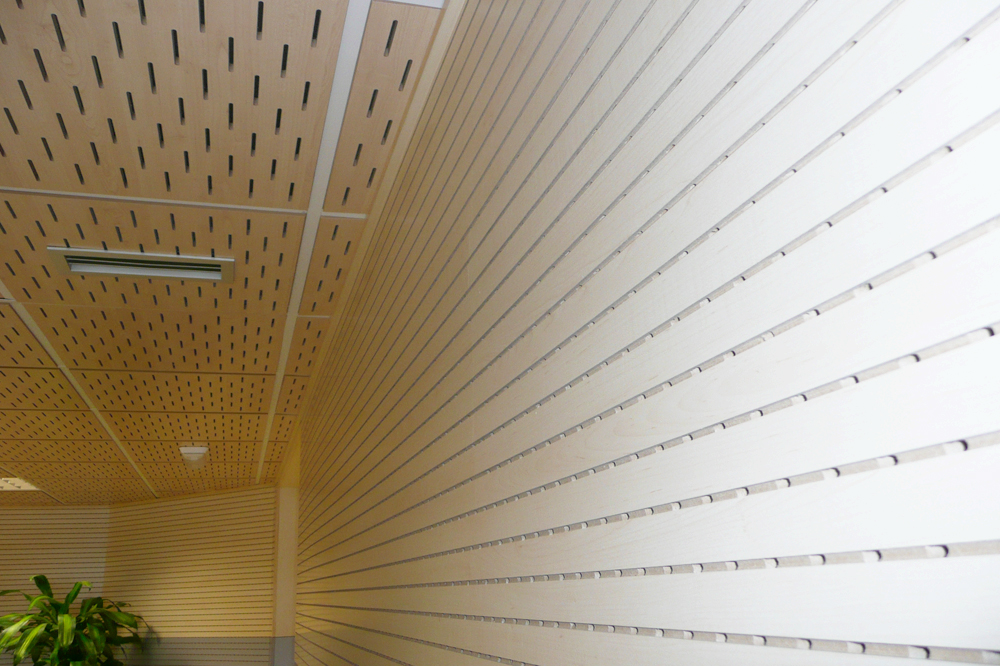
Spigogroup has launched a new catalogue of acoustic panels and tiles finished in melamine. Now, interior designers and decorators have more than 80 new alternatives from which to choose the finish of their acoustic panels and give their project the desired look. Spigoacustic and Spigotec brand wood acoustic panels are acoustic tiles made with MDF or plywood, to make them lighter, with an added finish in melamine, natural wood, lacquer, HPL or through-dyed MDF. The finish chosen will determine the final appearance of the acoustic panels and walls and acoustic ceilings. Melamine is one of the most popular materials for finishes. Melamine is an organic compound which combines with formaldehyde to produce melamine resin, a synthetic polymer which is fire resistant and heat tolerant. This resin is used to manufacture of melamine chipboard panels and the thin decorative surface layers used to finish them them. Melamine contributes certain features to acoustic panels, including resistance to alkalis, high softening temperature, heat stability and high heat and fire resistance, while providing a high degree of sound absorption and being insoluble in common solvents. In addition to these advantages, the new catalogue now offers and even wider range of options in acoustic panels and tiles finished in melamine. It includes new hardwood hues that are almost impossible to achieve in a natural way, finishes that imitate marble, slate, granite, and even some options that imitate concrete and metal. . Download New Catalog of Acoustic Panels and Tiles finished in Melamine     . If you liked this post about acoustic panels and tiles finished in melamine, you may also be interested in: . - Colour acoustic panels for decorative projects in shops - 5 Reasons why you should use obeche wood slats in your Project - Finishing options for wood fire doors - Wood slat panels for offices: the reception hall at Envaplaster
Read More