🍪
Skip to main content

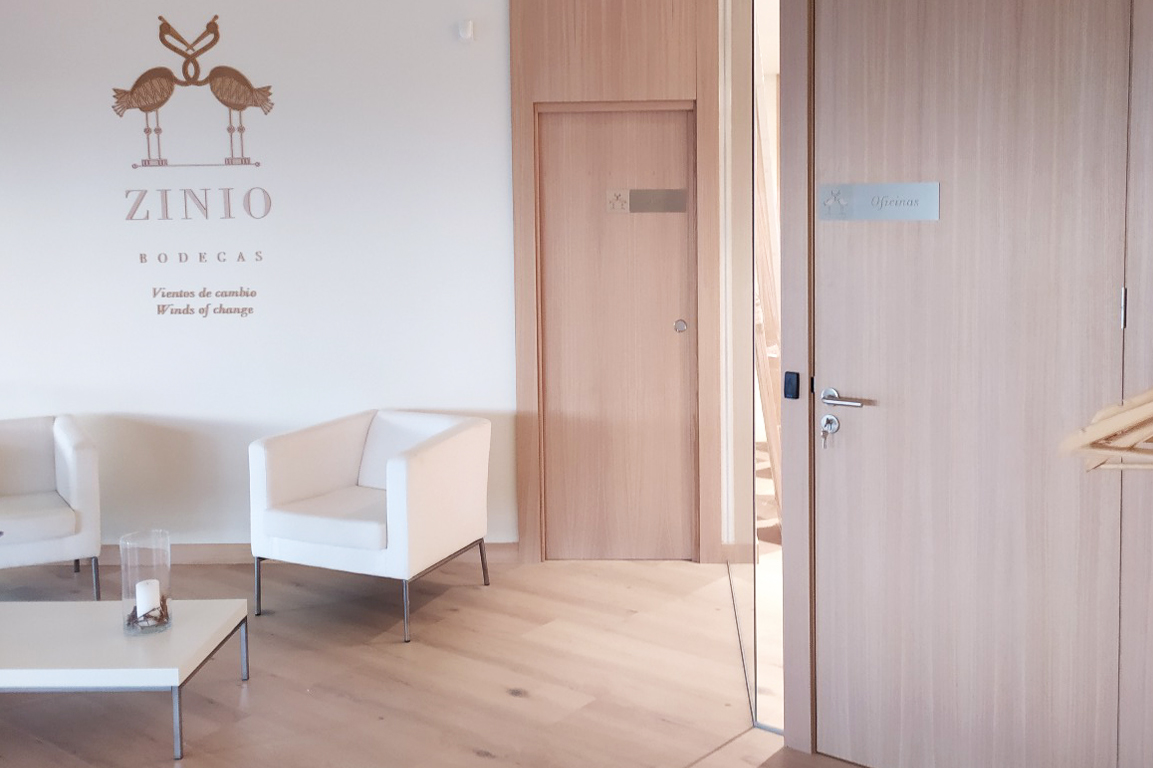
Wood slats, cladding and doors for wineries: the case of Zinio Bodegas Patrocinio

By Acoustics, Architecture, Construction, Decoration, News, Spigogroup wood projects No Comments
Here is a good example of manufacturing and installation of wood slats, wood cladding and wood doors for wineries. This is a wood decoration project in which we had the pleasure of participating in 2019 at Zinio Bodegas/Bodegas Patrocinio, the Uruñuela wine cooperative, in the heart of the Rioja wine region. Wineries are, without a doubt, businesses with close ties to the land. They also have a close relationship with wood. Grapes are born from the twisted vines that the land of Rioja has held since time immemorial. The grapes used to make the wines come from these vines, but the vines also produce the canes over which some of the increasingly valued dishes of Rioja cuisine are prepared. In addition, the ubiquitous oak barrels in wineries are used to age and store the superb Rioja Wines of international renown. It is therefore not surprising that Zinio Bodegas/Bodegas Patrocinio should opt for wood for its new offices and hospitality spaces. The cladding chosen for ceilings and walls are Spigoline model 5-15-70-55 wood slats. In addition, a technological platform and plank flooring were installed, as well as various bespoke special doors, flush doors and technical doors, including FR60 fire doors, finished in oak. These are pictures of the excellent final result:   . If you liked this post about wood doors for wineries, you may also be interested in:   - Inner linings and wood ceilings in wineries - Wood panelling in wineries: 6 examples - Wood slats for wineries: Marqués de Vargas - Interior design in wineries: the example of Bodegas Tobelos
Read More

4 Machined fixtures for easy installation of accessible ceilings

By Acoustics, Architecture, Construction, Decoration, News No Comments
Today we are going to show you four machined fixtures that allow you to seamlessly install accessible ceilings. And we are also going to do it graphically, aided by the drawings of the Spigotec catalogue of wood acoustic tiles. The following fixtures are easy to use and any installer (or anyone who is reasonably handy) will be able to seamlessly install accessible technical ceilings. . . . Exposed Form The exposed or flush mounting consists on the panels rest right above the profile, in this way, it is obtained a planimetry sensation in the ceiling. This system is registrable and allows access to plenum to the installation or inspection of the different elements (illumination, ventilation, among others). . . . . . . Semi-exposed Form The system of the semi-exposed form T-15/T-24 hides partially the profile leaving a fine line that adds elegance to the solution. The panel rests above fastening profile. This system succeeds in emphasizing the panels´ dimensions and forms which are made between them. . . . . . . . . Fineline Form The system of fineline form allows panels rest above the fastening profile and thanks to perimeter machining, these panels hang at par. This system adds an unique and special elegance which is based on the joint that is formed between wooden panels and mounting profiling. . . . . . . . . Concealed Form T-24 The system of concealed form T-24 simplifies the installation of panels for accesible ceilings. Through an inverted “T”, the panels are supported by the inverted “T” and concealed form is hidden between them. This system permits a very easy dismantling in order to their maintaining or to allow access to technical integrated installations in the ceiling. . . . . If you liked this post about Install accessible ceilings, you may also be interested in: . - 8 Spaces where sound-absorbent wood tiles should be used - Advantages of false ceilings that are still true with the new normal - Spigoplank decorative wood cladding - ACAE PRESTO and FIEBDC acoustic panels catalogue    
Read More

Improve the acoustics using wood slats

By Acoustics, Architecture, Construction, Decoration, News No Comments
The wood slat tiles can also help improve room acoustics. It depends on the model you choose. It is widely agreed that the main reason for choosing wood slats for interior cladding of ceilings and walls is purely aesthetic. The order and symmetry of the parallel arrangement of the slats, and the warmth and elegance of the wood, provide the perfect decorative solution. Moreover, they adapt, both technically and aesthetically, to any space. That is why we can see them in schools and culture centres, offices, dining rooms, meeting rooms, waiting rooms and common spaces in public or community buildings. However, wood slat tiles do not provide acoustic improvement if they are not specially designed for this purpose. Spigoline brand wood slat panels have an Acoustic System consisting of parallel solid wood slats with a square or rectangular cross-section on a plywood board with sound absorbent properties. This is because this board has similar perforations to those used by the traditional acoustic panels. The Spigoline Acoustic System offers panels with round or slotted perforations, consisting of 4 to 8 slats that are 20 mm high and 50 or 90 mm wide set at gaps of 55 or 130 mm between them. The standard slat length is 2400 mm, but custom lengths can be manufactured to meet particular project requirements. For further information on Spigoline acoustic system installation and finishes, please write to comercial@spigogroup.com   . If you liked this post about wood slat tiles, you may also be interested in: . - 5 Reasons to install Spigoline solid wood slats - Sound reflection, absorption and diffusion – Definition and treatment - Spigoline doubles the number of items in its catalogue of wood slat panels - Wood slats for wineries: Marqués de Vargas      
Read More

Acoustics in coworking spaces

By Acoustics, Architecture, Construction, Decoration, News, Spigogroup wood projects No Comments
The role of acoustics in coworking spaces is key to achieving the perfect blend of concentration and collaboration. Coworking spaces are, by definition, workplaces designed for professionals, startups, freelancers and small businesses to develop their business independently and, at the same time, to promote and develop joint projects. From the point of view of interior design and acoustic design, they are a challenge. Coworking requires open, spacious workspaces that facilitate interaction among users. These large spaces have been shown to encourage innovation and promote unity and participation, creation and knowledge. However, from the point of view of the comprehensive acoustics of a room these spaces are prone to reverberation. Reverberation is when a sound stays around longer than normal, making it difficult to hear and properly understand messages. Explained in a more technical manner, “reverberation time” is the time it takes for the sound to decay by 60 dB as received stood the sound emission source stops. In practice, reverberation is a nuisance when one is having a conversation, participating in a meeting or talking on the phone. In addition, it makes people involuntarily and unconsciously raise their voice, which in turn increases sound levels and noise pollution in the space. Installing solutions that fit in with the design of the office, such as acoustic panels or acoustic false ceilings, helps control reverberation and ensures good acoustics in coworking spaces. More information about acoustic tiles on the Spigocustic, Spigotec and Spigoline pages.   If you liked this post about acoustics in coworking spaces, you may also be interested in: . - The role of wood in green offices - 25 articles about designing and decorating offices with wood - Teleworking in architecture in the time of COVID-19 coronavirus: 5 guidelines - Spigogroup joins the EActivate movement
Read More