🍪
Skip to main content

The relationship between architectural acoustics and luxury

By Acoustics, Architecture, Construction, Decoration No Comments

Decorative wood acoustic panels are the technical and aesthetic solution where acoustics and luxury meet but, what is the relationship between these two concepts? Architectural acoustics and luxury are closely related, as both aim to create a comfortable and pleasing environment for the senses. Whilst luxury focuses on design, comfort and quality of materials, architectural acoustics is oriented towards the quality of sound and how it is perceived in a space. Indeed, one could argue that good acoustics is one of the identifiers of luxury. Luxury is a perception that affects all five senses. Thus, we recognise as luxurious the feel of the finest silk, the taste of the finest food or culinary preparations, the scent of a unique perfume or the visual pleasure of a work of art. As far as the sense of hearing is concerned, luxury is enjoying the best possible sound quality. This affects both the selection of sounds and music that reach our ears, and the sound quality with which we perceive them. This last point is where the best acoustics and luxury come together and where architectural acoustics and decorative wood acoustic panels do their job. Spigoacustic, Spigotec and Spigoline decorative wood acoustic panels are not luxury products, but they help in the acoustic conditioning of spaces, achieving excellent acoustics, with a clear, balanced and pleasant sound to the ear, and this does actively participate in the sensation of luxury that a space can transmit.           If you liked this post about decorative wood acoustic panels, you may also be interested in:   – Flush wood doors for houses, are they a good idea? What do they contribute? – The 7 advantages of using ayous wood interior cladding in your projects – 4 Trends in decoration for 2023 – 8 frequently asked questions about the use of wood slats in decoration    

Read More

Flush wood doors for houses, are they a good idea? What do they contribute?

By Architecture, Construction, Decoration, Inspiration, Spigogroup wood projects No Comments

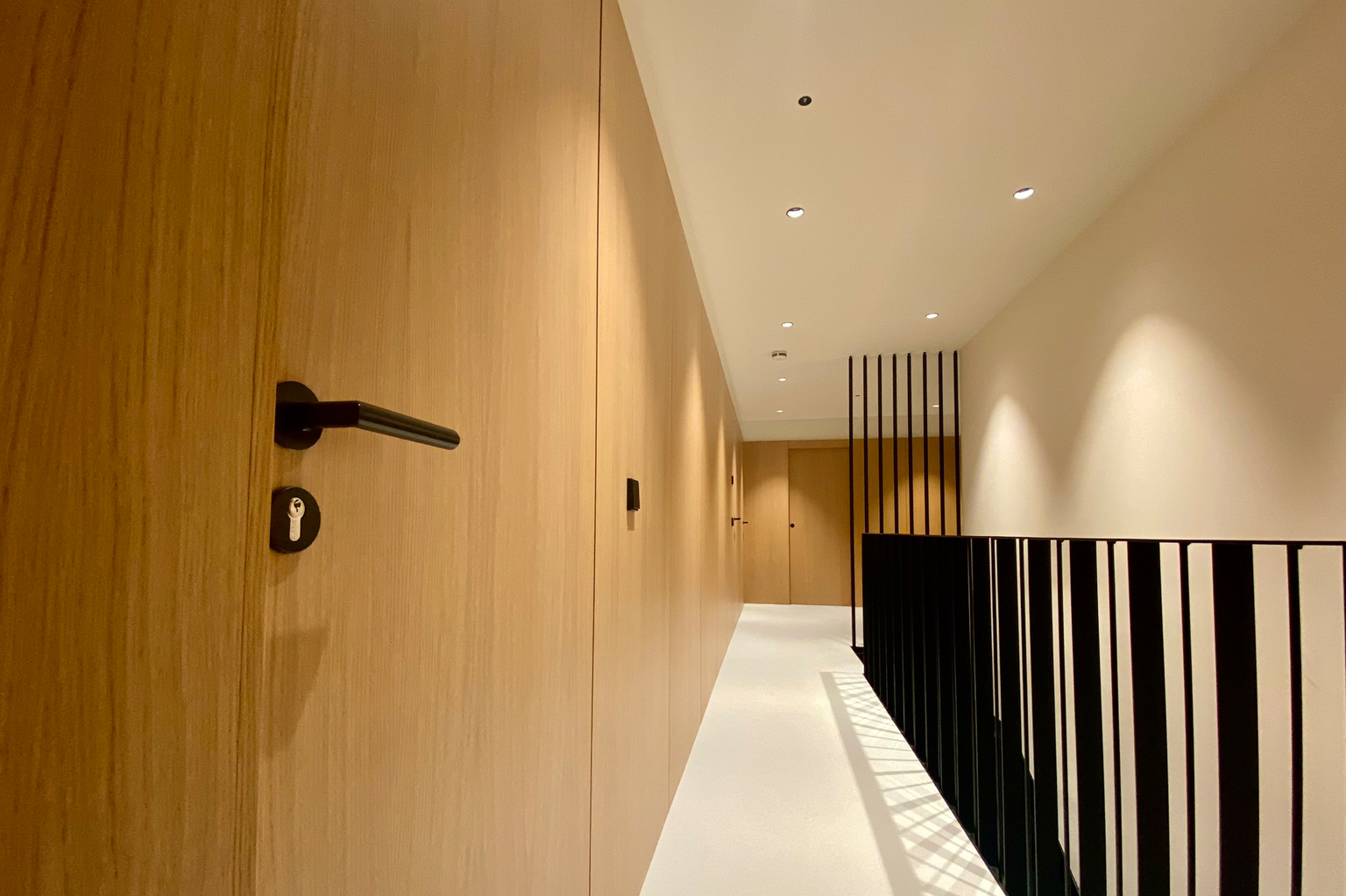
The first question has a quick answer: Yes, choosing flush wood doors for homes is a good idea. Let’s see what they are and what they contribute with a good example. The special system of rush door is the solution that allows installing a fully camouflaged door. Furthermore, this system gets to integrate the door into the wall and the environment until it retreated. Once installed, thanks to totally integration, these doors show all their qualities, giving greater emphasis to constructive details of its context. Thus, opting for flush wood doors, also known as integrated doors, invisible doors or hidden doors, helps to achieve continuous walls for modern, minimalist interior designs, clean of outstanding elements, where the focus is on space, light and colour. This interior design project in wood, carried out by the Riojan design and architecture studio Rodar Arquitectura in a single-family house, is a good example of this. In this case, a natural varnished veneered panelling was used for interior wood cladding in the corridors. The flush wood doors chosen featured the same material on the corridor side and an elegant white colour on the interior side of the rooms. In addition, they were manufactured with concealed hinges to avoid displaying fittings, and black handles were chosen as an elegant and sophisticated touch. The project was crowned with the installation of Spigoacustic 28-NO-16 sound-absorbing panelling in the headboards of the bedrooms, finished in varnished natural oak veneer, which, in addition to being in line with the aesthetics of the project, provided the acoustic comfort sought by the project.           If you liked this post about flush wood doors, you may also be interested in:   – The 7 advantages of using obeche wood interior cladding in your projects – 4 Trends in decoration for 2023 – The visual performance of accessible wood ceilings with concealed mounting systems – How we used decorative wood cladding at Bodegas Olarra      

Read More

The 7 advantages of using ayous wood interior cladding in your projects

By Acoustics, Architecture, Construction, Decoration, News, Spigogroup wood projects No Comments

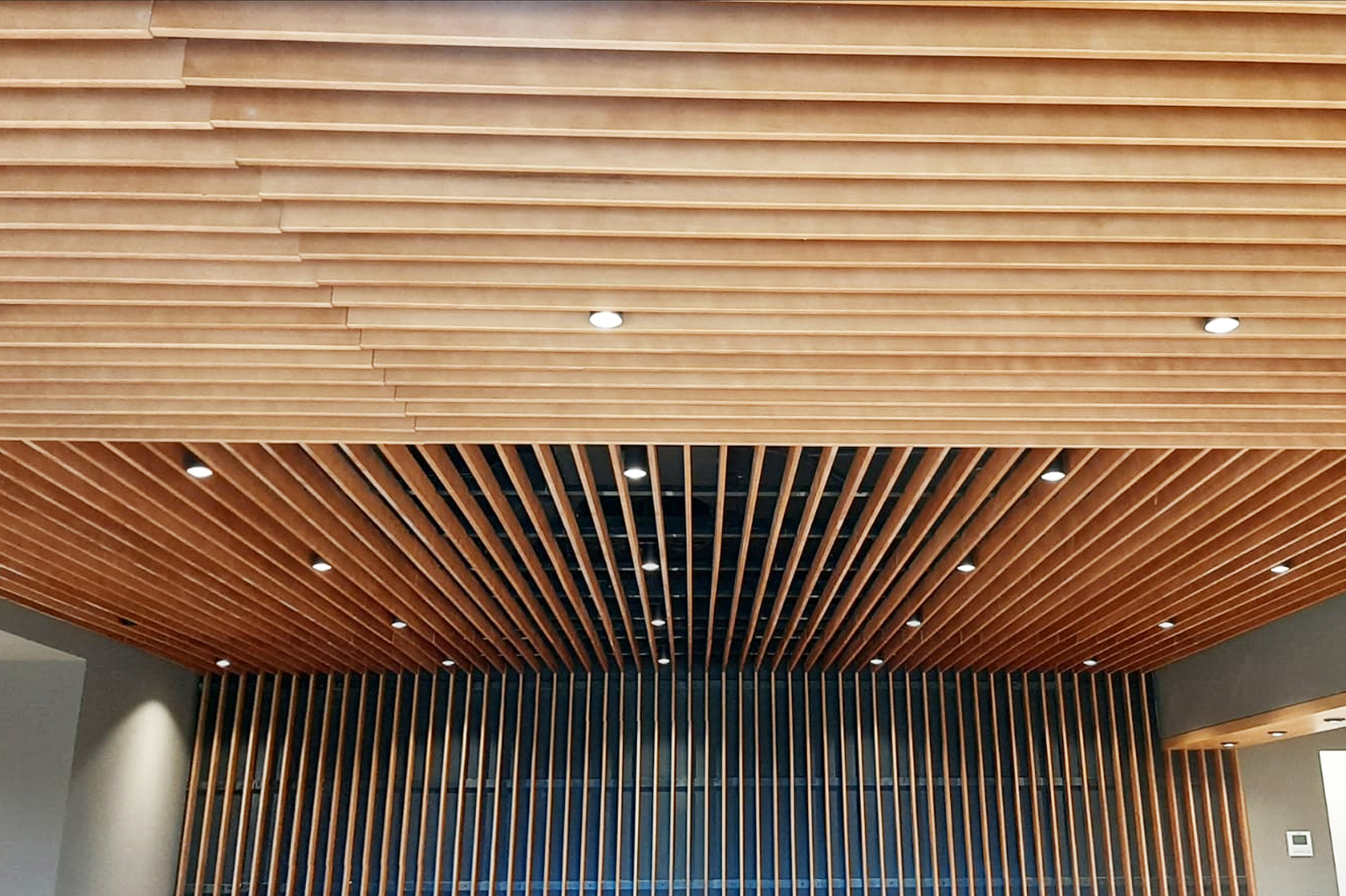
Using ayous wood in decorative interior cladding offers a number of advantages. At Spigogroup we manufacture our Spigoline brand wood cladding for walls and ceilings, with samba or ayous wood slats and strips . We can produce them with any other wood (pine, chestnut, oak, etc.) upon request, but we prefer obeche wood. These are the main reasons why we chose this wood:   1.- Ayous wood is very lightweight With a density of 390 kg/m³, it is much lighter than other woods. It can be easily handled by one person, making it easier to produce, place and transport. In false ceilings, it requires fewer supports, so it is also quicker and cheaper to install. Being lightweight, is also offers a clear advantage in countries where anti-seismic regulations limit the surface density of a false ceiling assembly. For example: our Spigoline 4-30-70-55 wood plank cladding, made of ayous wood, has a surface density of less than 10 kg/m². If we chose pine, the density would be 12.5 kg/m² (+25%), and with oak, 18.46 kg/m² (+84%), i.e. heavier structures with more supports, which increase costs without adding any functionality.   2.- Ayous wood has excellent dimensional stability Dimensional stability is the degree to which wood can shrink or warp due to temperature or humidity. Ayous wood has excellent dimensional stability, much better, for example, than oak wood, the noble wood par excellence, which is nonetheless more prone to warping. Ayous wood contracts and expands less than other woods, so it therefore uses smaller expansion joints, for improved surface visual continuity whilst making it easier to do calculations before installing. Ayous wood deforms less than other woods, which is why Spigoline can assure perfect alignment between planks, stable throughout the life of the installation.     3.- Ayous is a soft, easy-to-treat wood Ayous is a soft wood, but this is not a problem because it is installed in false ceilings or places out of reach, so it does not detract from the functionality of the final product. In return, it is easier to handle, drill and shape, thus speeding up the production process, reducing errors, reducing material waste and offering better value for money.   4.- Light colour that can be tinted and finished in many ways Ayous wood is very light in colour, so it can be stained to achieve darker wood finishes or other solid colours. It also has few knots and straight fibres, providing greater smoothness to the final appearance. In addition, it absorbs treatments like autoclaving quite well, enabling improved fire and weather resistance.   5.- Ayous wood can achieve B-s1,d0 fire performance Low density and good absorption capacity in autoclave immersion processes allows it to obtain a B-s1,d0 fire performance. This classification is more difficult to achieve with other denser woods with absorption problems, which end up with lower levels of effectiveness (B-s2,d0, B-s3,d0 or C or D classifications).     6.- The ayous wood used in Spigogroup comes from sustainable sources Spigogroup is ISO 9001, ISO 14001, PEFC and FSC certified. These certifications ensure our respect for environmental protection standards, the quality of our products, that they have been manufactured with wood from sustainably-managed forests and that a Chain of Custody System has been maintained that reaches the final product.   7.- Shorter lead times We manufacture ayous wood cladding every day, which means that we always have it in stock and can offer shorter lead times.         If you liked this post about ayous wood interior cladding, you may also be interested in:   – 4 Trends in decoration for 2023 – Designer ceilings with solid wood slats at Leyre Monastery (Part 1) – Spigogroup’s Spigoline brand A+ wood slat cladding – Wood slat panels for office ceiling and wall decoration          

Read More