🍪
Skip to main content

Wood offices: Are they just a fad? What advantages do they offer?

By Architecture, Construction, Decoration, Inspiration, Spigogroup wood projects No Comments

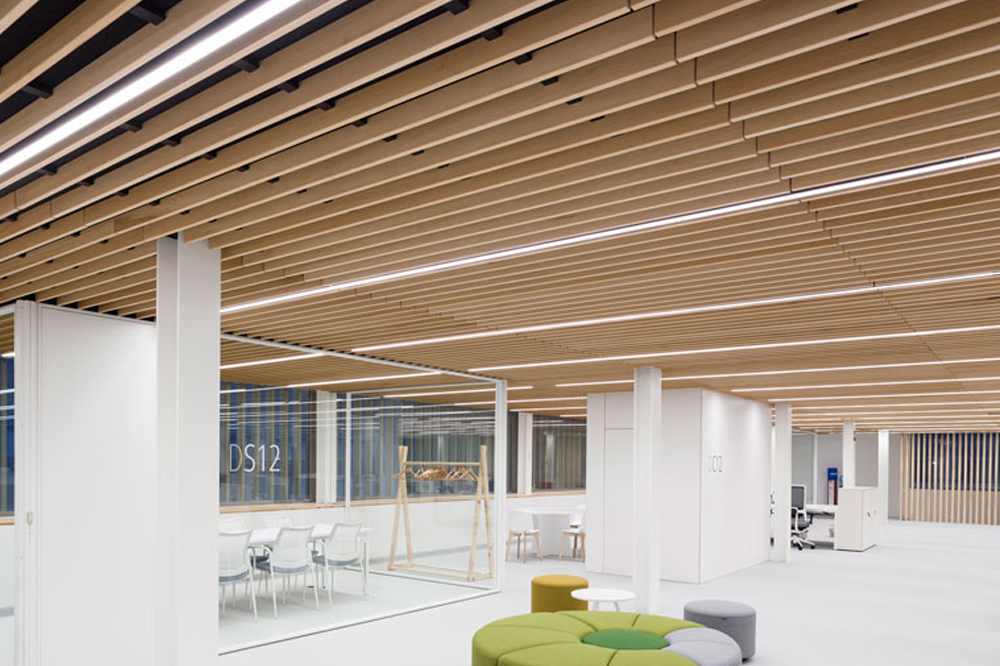
Wood offices change the lives of thousands of working people every day. Wood has been revealed as the perfect material for the design and construction of workplaces. So much so that, at present, prestigious architects and decorators are consistently proposing a more or less intensive use of wood (wood celings, walls, furniture) in their projects. Why?   They are a trend, they are fashionable: Some styles (nordic, ethnic) have captivated consumer tastes. Other styles (industrial, rustic or vintage) also include the extensive use of wood in their proposals. Wood offices transfer this trend to working environments. This does not only affect the furniture but also involves the choice of wood panelling for walls, floors and ceilings, compared to other materials.   Employee welfare: Working in an appropriate setting makes people feel good and, as a result, improves the quality of their work. The use of wood in office design helps to achieve a natural, warm, balanced and motivating environment. Users, whether employees or customers, feel much more comfortable in a more natural, welcoming space. It has been amply demonstrated that offices decorated with wood (wood design ceilings, wood slats on walls and ceilings, wood panels in inner linings, etc.) are more attractive.   Ecology and commitment to nature: environmental awareness and environmentalism, together with the inclination of human beings to keep in touch with nature has reinforced the wood as the material of choice. Wood is the most natural building material. It is also a renewable, natural and organic resource that is both a thermal and an electrical insulator.       If you liked this post about wood offices, you may also be interested in: – 8 Questions fréquemment posées sur les solutions acoustiques pour bureaux – The spectacular wood slat false ceiling at the new FINSA headquarters offices – The three types of office doors made of wood most commonly used today – Office ceilings that improve the look and acoustics of a workplace  
Read More

Five good examples of decorative wood strips and slats on office ceilings

By Architecture, Construction, Decoration, News, Spigogroup wood projects No Comments

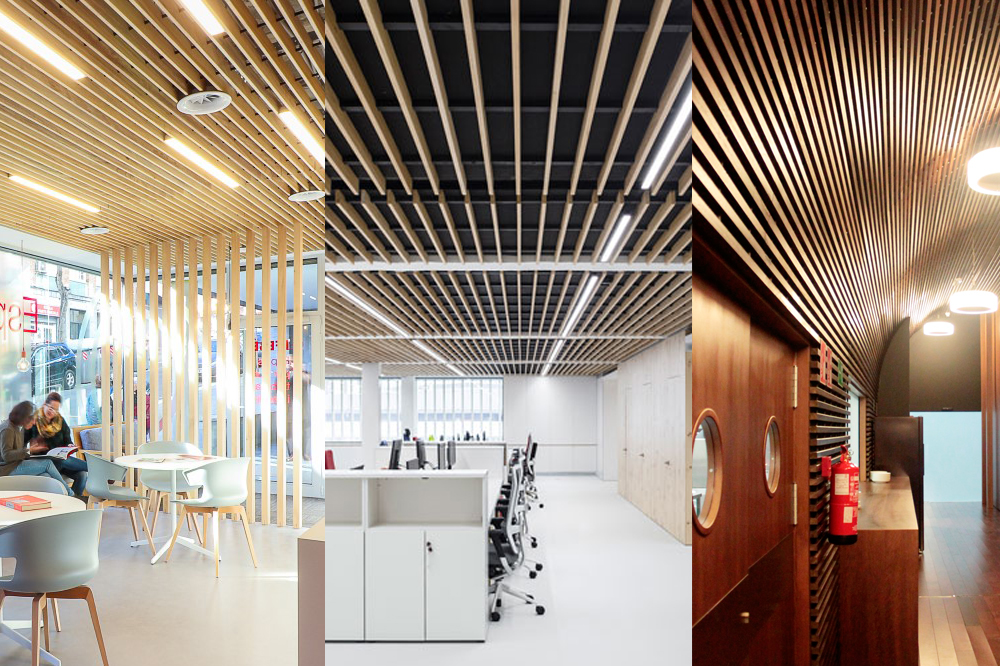
Decorative wood strips and slats have gone from being a curious, unusual component to being present on the ceilings of a large number of offices. On the one hand they have an indisputable aesthetic value. On office ceilings, decorative wood slats provide an orderly, modern perspective of the space they crown, making the rooms seem larger than they really are. In addition, they serve to discreetly and elegantly hide spotlights, downlights and other ancillary components, like sensors and speakers. Also, depending on the model of wood slat panels chosen, it can be used to improve room acoustics. This is the case of the acoustic system designed by Spigoline, the Spigogroup division devoted to manufacturing decorative solid wood slats. Here are 5 good examples of decorative wood strips and slats in office ceilings. All are included in Spigoline’s solid wood slat cladding catalogue:   The OHIM European Agency in Alicante For this project Spigoline Grid System wood slats were used with a ceiling mounting clip installation system. The chosen model of wood slats was the 6-30-35-30 which has 6 30 mm wide wood slats and a separation of 30 mm between slats. The grids are 35 mm high, 360 mm¡ wide and 3000 mm long. The wood slats were finished in solid obeche wood stained with flame retardant B-s2, d0 varnish.     The Autodesk offices in Barcelona For the design ceilings with ceilings made with solid wood slats at the Autodesk offices we manufactured and supplied wood slats (model 4-30-70-55 of Grid System). This model features 4 slats of wood in each module which are 30 mm wide and 70 mm high, with a separation between components of 55 mm. For this work the solid Ayous tinted finish was chosen with B-s2, d0 flame retardant varnish.     FINSA headquarters The chosen wood slat model was the Spigoline 4-20-70-100, with a black upper crossbar, a slat section of 20×70 mm, grill width of 500 mm and a finish in obeche wood with natural varnish B-s2, d0.     EFEBÉ Group offices In this case, approximately 50 m² of grids made with wood slats Spigoline . They are the Spigoline GRID system with model 5-15-70-55 finished in obeche wood with colourless flame retardant varnish and installed using the T-15 system. Each grill of this model is 3000 mm long and 350 mm wide and has 5 slats 15 mm wide and 70 mm high gridded with black rods.     Centro de Formación Canario headquarters The Grid 4-30-70-35 model of the Spigoline wood slat decorative panel system was chosen. The model consists of four, 30 mm wide and 70 mm high slats with 55 mm spacing, forming a grid with black rods. The grids are 340 mm wide and 2100 mm long, and are installed with fastening clips. Solid obeche wood with oak stain was chosen as finish for the wood panelling and false ceiling.       If you liked this post about decorative wood strips, you may also be interested in: – Curved wood slats for spectacular design ceilings – 5 Reasons why you should use obeche wood slats in your Project – Spigoline doubles the number of items in its catalogue of wood slat panels – Wood slat panels for offices: the reception hall at Envaplaster    

Read More

I want decorative wood ceilings in my project, what are my choices?

By Acoustics, Architecture, Construction, Decoration, News, Spigogroup wood projects No Comments
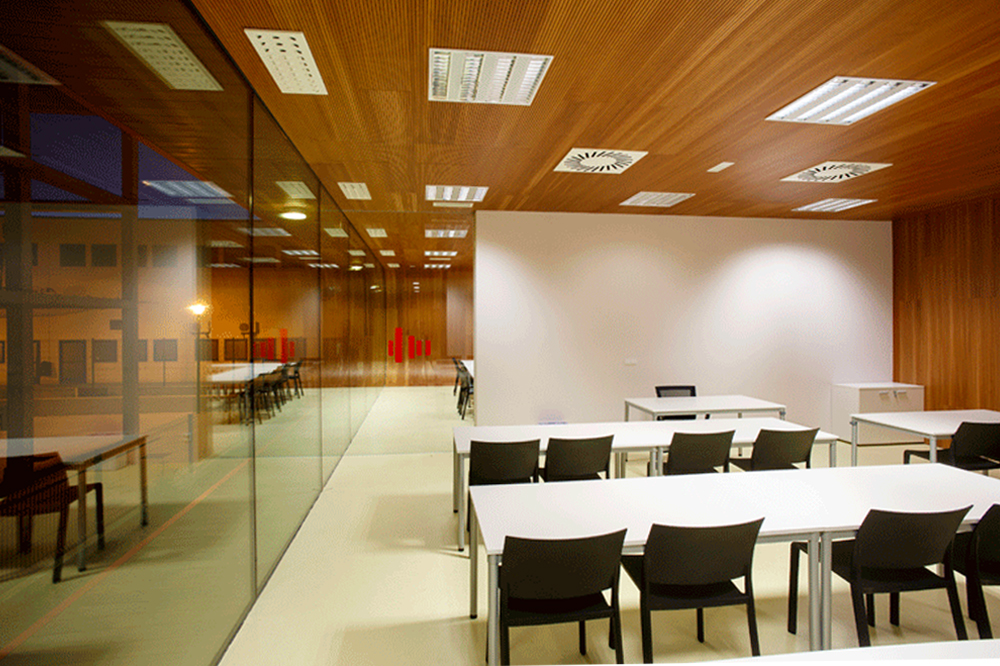
Decorative wood ceilings play a key role in the décor and features of any space. That is the reason why the chosen hue or finish, the type of installation, the shapes and models of ceiling tiles or the acoustic performance required of decorative ceilings condition the final choice. All these aspects also affect the luminosity, visual environment and sound clarity of the room. So, if you want decorative wood ceilings in your project, what are your choices? . Standard wood ceilings: these are wood ceilings that are placed directly on the original ceiling or framework, just like any other wood panelling. They differ from false ceilings in that they do not leave a space between the wood ceiling and the original ceiling. There is an enormous number of finishes to suit your decorating requirements.   False ceilings: these are suspended, leaving an empty space above them. You can choose between removable ceilings and accessible ceilings. Accessible ceilings quick, direct access to any part of the wood ceiling, while removable ceilings require removing part of the false ceilings to reach the exact place where we wish to work. The catalogue of finishes is similar to that of standard ceilings.   Acoustic ceilings: these are a type of false ceiling made with sound-absorbent acoustic panels. They are used when acoustic conditioning is required in a room. They can be continuous or accessible and come in the same range of choices as the other false ceilings.   Wood slat ceilings: they consist of wood slats, which bring order, cleanliness, perspective and a sensation of modernity. There are also acoustic models.   Undulating ceilings: these can be made with either wood panels or wood slats. These are the design ceilings that are most prominent in a project.   Acoustic island ceilings: these come in layers at different heights that provide an aesthetic identity and dynamics beyond the acoustic purpose for which they were designed. . If you liked this post about decorative ceilings, you may also be interested in: . - Acoustic design ceilings: the fusion of aesthetics and technology - Interior wood ceilings in the work of Kengo Kuma - What are technical ceilings? What are they for? - Technical ceilings for hospitals and medical centres: why is it so easy to integrate equipment and devices  
Read More

Wood fabrics and structures in the interior ceilings of Shigeru Ban’s project

By Architecture, Construction, Decoration, Grand Master, Inspiration, News No Comments
Shigeru Ban's interior ceilings offer incredible surprises. Those who have the opportunity to visit some of the buildings of this famous Japanese architect and 2014 Priztker Prize winner immediately discover a world of cardboard and wood that defies the conventional. Although Shigeru Ban is also known for his efforts in creating shelters for victims of natural disasters such as the 2011 Japan earthquake or the 2013 Sri Lanka tsunami, he is also the author of iconic buildings. Below we show five key projects by Shigeru Ban where interior ceilings show novel structures and evocative wood fabrics.   Centre Pompidou-Metz This annex to the Pompidou Centre, designed by Shigeru Ban in 2010, sports a structure consisting of a wood ceiling that forms a hexagon, a geometrical figure with a special meaning for the French as they consider it symbolises their country because as it has an analogous shape. Photos and information obtained from www.shigerubanarchitects.com   Villa Vista In this house built in Sri Lanka after the 2010 tsunami, Shigeru Ban uses teak wood interior ceilings woven into a wicker pattern. Photos and information obtained from www.shigerubanarchitects.com   Aspen Art Museum The building features an impressive wood façade with basket-like braiding. Photos and information obtained from www.shigerubanarchitects.com       Nueve Puentes Country Club Here, the architect projected graceful columns of laminated wood that open to the sky in a radial arrangement, rising vertically and curling to achieve horizontality on the plane of the roof forming design ceilings in a hexagonal grid. Photos and information obtained from www.shigerubanarchitects.com   Tamedia Office Building For the headquarters of the Swiss Tamedia company in Zurich, Shigeru Ban chose wood for its spectacular structural system because it is a renewable material and the one with the lowest carbon footprint in the construction process. Photos and information obtained from www.shigerubanarchitects.com   . If you liked this post about interior ceilings, you may also be interested in: . - Go Hasegawa and the use of wood panelling for walls and ceilings - Interior wood ceilings in the work of Kengo Kuma - The use of wood in new Moroccan Architecture - 10 Examples of the use of acoustic tiles for auditoriums
Read More