🍪
Skip to main content

5 shining examples of the use of wood in ceilings

By Acoustics, Architecture, Construction, Decoration, Inspiration, Spigogroup wood projects No Comments
The use of wood in ceilings is ancient. In the early days of architecture all roofs and ceilings in buildings were made of wood because it was a much lighter material than stone or brick. The big catch was that it burned easily, and more so in those buildings lit by candles, torches and oil lamps. Few ancient wood ceilings have survived to this day. Some were devoured by parasites and others by flames. However, we maintain our taste and predilection for a material as elegant as wood. Even in the most modern designs we choose wood in ceilings and walls because of the elegance and warmth it brings to the whole. These are 5 good examples of projects that chose to use wood in ceilings and got it right:   The Footwear Technology Centre (CTCR) in La Rioja and its wood ceilings with Spigoacustic cladding and Spigotec wood accesible ceilings.       The geometric ceilings of the Saudi Press Agency in Riyadh consist of prisms of Spigotec Leo 16 and Spigotec Smooth panels finished in cherry wood veneer.       The ceiling that joins the wall in the offices of the Fundación Laboral para la Construcción in Logroño made with Spigoacustic wood cladding finished in varnished oak.       The Bilbao City Hall Mayors’ Room with its spectacular ceiling of Spigoline Grid 5-15-70-55 wood slats finished in stained obeche wood.       The offices of the Berriozar Town Council and its spaces crowned by elegant Spigoacustic acoustic ceilings.   . If you liked this post about wood in ceilings, you may also be interested in: . - Why choose sound-absorbent wood ceilings for cinemas? - Benefits of natural wood acoustic tiles for walls and ceilings - Do you install ceiling cladding for aesthetics or out of necessity? - New online tool for price quotes for acoustic panels, wood ceilings, technical doors, etc.
Read More

School lockers are more necessary than ever

By Architecture, Construction, Decoration, News No Comments
School lockers are an item that has become increasingly important in our country over the years. We used to see them in schools and colleges in American films. In Spain there were only a few schools that had lockers. We're talking about those old metal lockers, even wood ones. But now, we can discover them in all types of kindergartens, schools, colleges, academies and universities. The growth in the demand for and use of school lockers makes sense. Students have been increasing the amount of books and school materials they carry on their backs. In some cases they can weigh as much as 30 per cent of the student’s body weight, when it should never exceed 10 or 15 per cent. The result is that, according to school experts and health authorities, 50 per cent of children under 15 and 70 per cent of girls suffer from back pain because of this. On the other hand, technological developments mean that students of increasingly younger ages are coming to schools with mobile phones, tablets and other very fragile and expensive devices. In addition, in many cases, students are not allowed to take these devices into the classroom. Finally, the safety rules of the post-COVID-19 era emphasize the need to keep personal items out of the hands of others. Without a doubt, today it is essential that schools have a place, such as school lockers, where students can store their belongings during the school day.   MORE INFORMATION ABOUT SCHOOL PHENOLIC LOCKERS   MORE INFORMATION ABOUT SCHOOL SPORTS FURNITURE   . If you liked this post about school lockers, you may also be interested in:   - What are phenolic booths? And phenolic lockers? - 10 advantages of phenolic booths and phenolic lockers - 7 articles that you should read about phenolic booths and phenolic lockers - Phenolic lockers and phenolic booths, perfect for sports facilities
Read More

Spigodoor door edge and interior options

By Acoustics, Architecture, Construction, Decoration, News No Comments
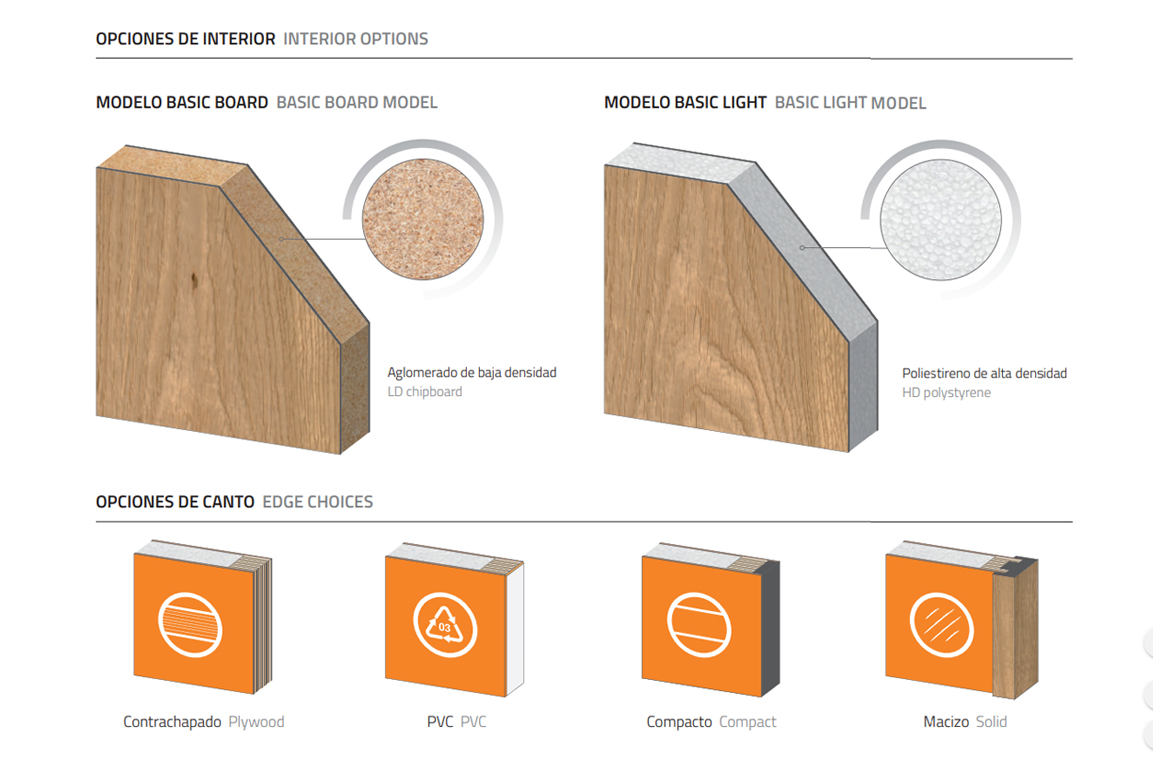
Knowing the edges and interior of wood doors of the Spigodoor Basic Series will help you find the model that best suits the needs of our project. If required, Spigodoor also has an extensive catalogue of technical doors manufactured in Spain, which includes acoustic doors, with different degrees of soundproofing, and fire doors / FR doors, with different responses to the spread of fire. Within the basic Spigodoor series, you can choose between two different types of interiors or door cores:   The Basic Board model, made of low-density chipboard. This material is ideal for use in dry environments and for the manufacture of doors because it has a smooth, homogeneous surface and offers high stability and low levels of swelling. In addition, it is easy to transform and manipulate.   The Basic Light model, made of high-density polystyrene. A very lightweight material that offers excellent thermal insulation and soundproofing, as well as low water absorption and high mechanical resistance.   In addition, the basic Spigodoor series allows you to choose from four different edge options: plywood, PVC, compact and solid.       Once the interior configuration of the wood doors has been completed, all that remains is to choose the finish that we like best. You can choose MDB finishes to paint, laminated HPL formica, natural wood veneers or lacquered finishes. More information about technical doors and wood doors in the Spigodoor catalogue.   DOWNLOAD SPIGODOOR TECHNICAL DOORS CATALOG .. If you liked this post about interior of wood doors, you may also be interested in:   - Spigodoor Rapid Technical Doors Service - The three types of office doors made of wood most commonly used today - Fire Resistant Doors and the four basic rules for proper operation - Doors for schools, universities, secondary schools and nursery schools: technical, acoustic, fire (RF) or anti-pinch doors.
Read More

Advantages of false ceilings that are still true with the new normal

By Acoustics, Architecture, Construction, Decoration, News No Comments
The traditional advantages of false ceilings continue to be valid now that we are introducing the so-called "new normal". Although we are convinced that, little by little, we will win the battle against the COVID-19 pandemic, the hard journey we are facing will leave its mark. Changes in our perception of the world, in how we feel secure, in what is really important and in the relationship we have with our environment will last for years, probably decades. Everything is changing because everything is receiving the veneer of the new normal. However, many things around us will remain valid because they have universal values. Among the advantages of false ceilings that remain valid with the new normal is the feeling of shelter offered by lowering the ceiling. The proximity of the ceiling to our heads reinforces the feeling of protection of the "cave" or "hut". And if we talk about false wood ceilings the effect is even more noticeable. The need to feel safe is more present today than ever before. In addition, a prolonged stay in enclosed environments due to lockdown measures has put a premium on the acoustics of the spaces in which we live. Acoustic false ceilings include acoustic panels that improve the clarity with which we hear sounds and conversations. .       If you liked this post advantages of false ceilings, you may also be interested in:   - Finitions de plafonds Spigogroup. Laquelle choisirez-vous pour votre projet? - Decorative ceilings that improve acoustics in enclosures - How to choose a ceiling finish in a decoration Project - How does wood decoration and interior design affect us?
Read More